The photo looks perfect. Golden hour light on the rig, mountains in the background, kids laughing near the fire. You’ve seen it a thousand times. Maybe it’s part of why you’re reading this right now, because something about that image pulled at you and made you wonder if a life like that was possible for your family too.
We’ve posted that photo. A lot of versions of it, actually. And it’s real. Those moments happen, they’re as good as they look, and we don’t regret a single one of them.
But there’s a version of this life that doesn’t make it into the post. The version that exists in between the golden hour shots. The part that nobody in the RV content space talks about honestly enough, and the part that we think people deserve to hear before they make a decision this big.
This is that version. Five years of full-time RVing, told straight.
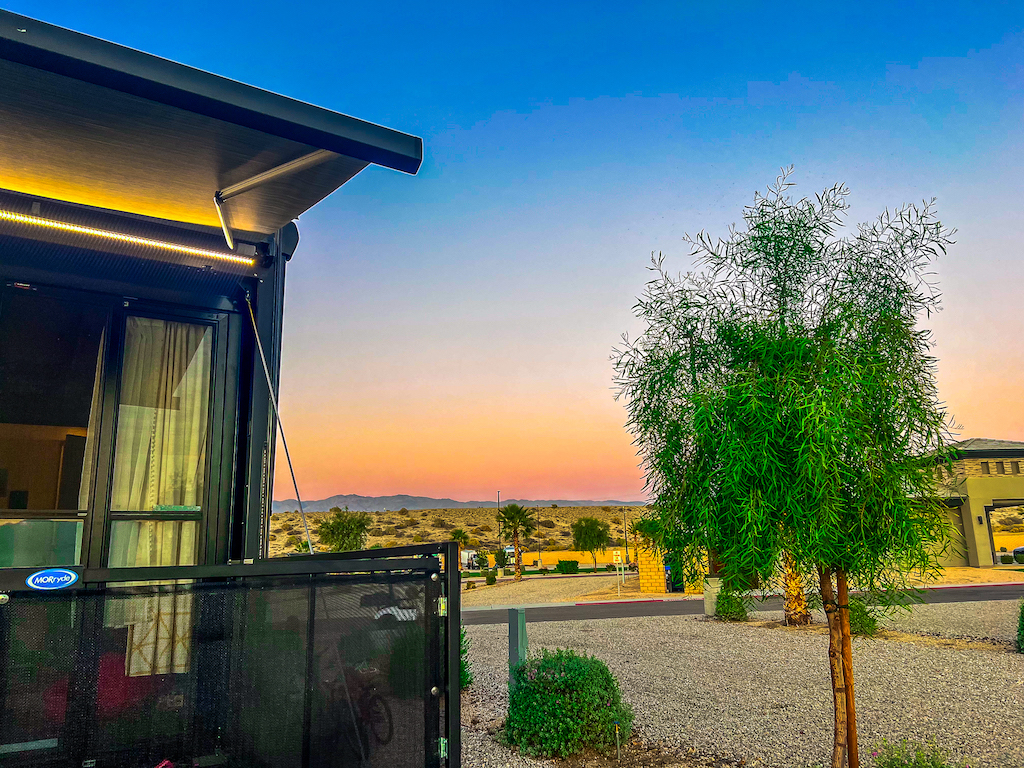
Sometimes You Just Don’t Feel Like Camping. Because You’re Not.
This is the one that surprises people most when they get into full-time RV life, and it’s the hardest one to explain until you’ve lived it.
When you’re a weekend camper, every trip is an event. You pack with intention, you leave the routine behind, you arrive at the campground and you’re in adventure mode. The whole thing has a beginning, a middle, and an end. And when it’s over, you go home.
Full-time RV life doesn’t work like that. The campground is just where you live. The RV is just your house. Tuesday is just Tuesday. And some Tuesdays, a lot of them, honestly, you’re not in adventure mode. You’re tired. You have work to do. Someone is sick. The kids are bored and bickering. The weather is bad and you’re all inside a small space with nowhere to go.
The romance of it doesn’t sustain itself automatically. It has to be maintained intentionally, and there are stretches where you’re just… living. Not adventuring. Not exploring. Just getting through the week like everyone else, except your house has wheels and the WiFi is inconsistent.
Nobody posts that version. We understand why, it doesn’t photograph well and it doesn’t fit the brand. But it’s real, and the families who thrive long-term in this life are the ones who went in knowing it exists and made peace with it. The ones who struggle are often the ones who expected every day to feel like a camping trip and couldn’t reconcile it when it didn’t.
Full-time RV life is a great life. It is not a permanent vacation. The sooner you understand that distinction, the better equipped you’ll be for the reality of it.
Follow Us on Instagram!
The Job Doesn’t Stop Because You’re on the Road
The fantasy version of full-time RV life involves a lot of morning hikes and afternoon campfires and spontaneous detours down scenic roads. The real version involves sitting in the bedroom of a toy hauler on a Tuesday morning answering emails while the kids do school at the kitchen table and your spouse is on a call in the only other quiet corner of the rig.
Work doesn’t pause because you’re parked somewhere beautiful. Deadlines don’t care about the view. Clients don’t care that you drove eight hours yesterday and are running on four hours of sleep. If your income depends on showing up and delivering, and for most full-timers, it does, then the road is just your office location, not an excuse to check out.
For families especially, this creates a real tension that takes time and systems to manage. You’re trying to work, your kids are trying to learn, your partner is trying to hold everything together, and you’re all doing it in the same few hundred square feet. There are days when that hum of everyone doing their thing in a small shared space feels warm and connected. And there are days when it feels like too much overlap with not enough room to breathe.
The people who navigate this well aren’t the ones who figured out how to escape their work responsibilities, they’re the ones who figured out how to carry them efficiently.
Boundaries around work hours. Dedicated spaces for focus even in a small rig. Communication with kids about when Mom and Dad are unavailable. Systems that create structure when the environment around you is constantly changing.
It’s doable. We’ve been doing it for five years. But it requires real intentionality, and anyone who tells you that working from the road is easier than working from a house has probably never tried to take a client call while two kids debate what’s for lunch three feet away from you.
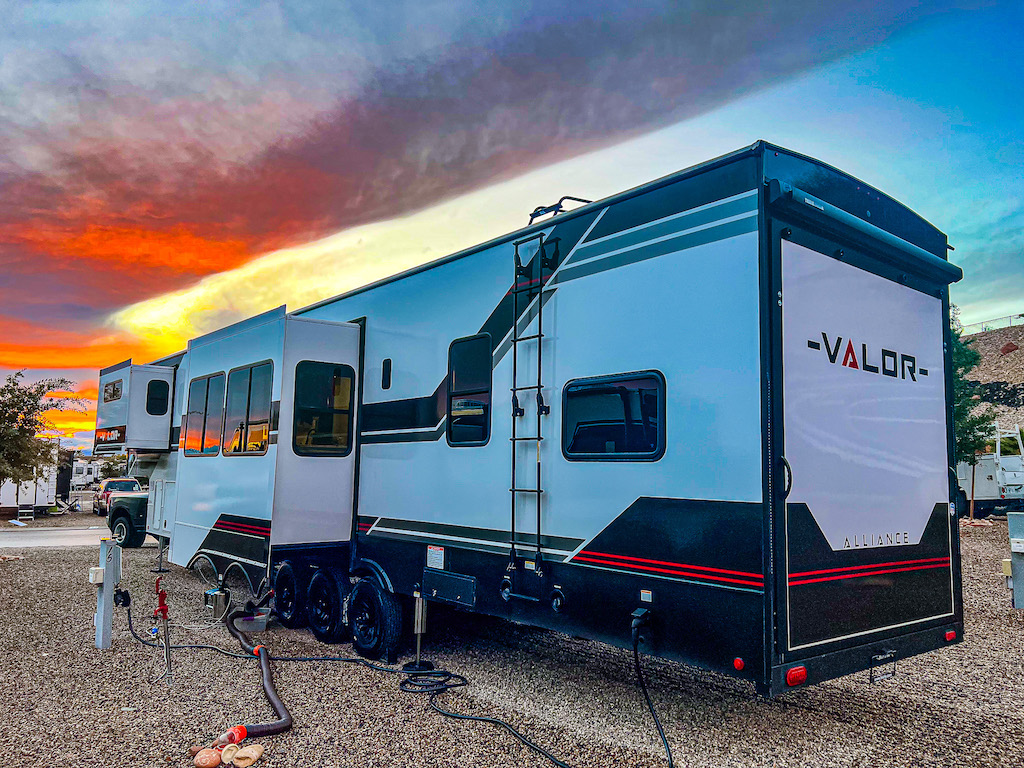
Not Every Site Is Level. And Some Days That Matters More Than You’d Think.
Here’s one that sounds minor until it’s not.
Campground sites vary wildly. Some are beautifully level concrete pads that make setting up a five-minute exercise. Others are sloped gravel patches where you spend twenty minutes with leveling blocks trying to get close enough to be functional, knowing you’re never going to get it perfect. You do the best you can, you pull your slides, you set up, and then you notice the slight tilt when you walk across the floor, or you wake up in the night having slowly rolled to one side of the bed, or your coffee slides across the counter on its own.
Over the course of a few days it’s fine. Over the course of a week in a site that just won’t cooperate, it’s quietly exhausting in a way that’s hard to articulate. It’s a constant low-grade reminder that you’re not quite settled, that the environment is slightly off, that home right now is a minor inconvenience in a way that a house on a foundation never is.
There are also sewer hookup situations to consider. Not every site has them. Not every park has a dump station that’s convenient or clean. There are days when tank management is a real logistical consideration and not a minor one, and those days don’t make the highlight reel. You learn systems for it. You get used to it. But it’s part of the life and it would be dishonest to pretend otherwise.
The same applies to laundry. When you have full hookups and a washer-dryer setup in the rig, it’s manageable. When you’re in a site without that option, you’re finding the campground laundry room, which ranges from perfectly functional to deeply questionable, or you’re making a trip to a laundromat in whatever town is nearby.
With a family of four, laundry doesn’t stop being a thing just because you’re on the road. It just becomes a thing you have to solve differently every few days depending on where you are.
None of this is insurmountable.
Experienced full-timers develop routines and preferences and workarounds for all of it. But in the early months especially, the accumulation of these small logistical frictions, like the leveling, the tanks, the laundry, the site that’s nothing like the photos on the booking app, they can add up in ways that feel heavier than any individual issue would suggest.
The Urge to Eat Out Is Real. And It Will Eat Your Budget.
Nobody talks about this one and it is one of the most consistent budget challenges in full-time RV life.
When you’re traveling and in a new place, eating out feels like part of the experience.
You’re in a town you’ve never been to, there’s a restaurant with good reviews, and cooking in the rig feels like a missed opportunity to experience the place you’re in. That logic is completely understandable and it’s not entirely wrong. But it applies to every new place you stop. And if you’re moving regularly, you are always in a new place.
The math on that adds up fast. A family of four eating out even a few times a week, across every stop on a year-long trip, can add thousands of dollars to annual costs that were never in the original budget. And the slippery slope is real because one meal out becomes two because you’re tired from a travel day, becomes a habit because cooking in a small kitchen after a long day is genuinely less appealing than walking into a restaurant.
Add to that the days when you’re just not in the mood to deal with the RV kitchen and the limited storage and the three-step dance required to get things in and out of the right cabinets, and the path of least resistance is pointing very clearly toward a drive-through.
Full-timers who manage their food budget well aren’t people who never feel that pull. They’re people who built systems to resist it: meal planning before moves, stocking the rig before arriving somewhere remote, treating eating out as an intentional choice rather than a default.
It sounds simple.
In practice, with two kids and a travel day and a site setup and work waiting and a kitchen the size of a galley on a boat, it takes real discipline. And some days the discipline isn’t there. That’s okay. But go in knowing it’s a real pressure point, because it catches a lot of people off guard.
The Hard Stuff Has a Way of Stacking
None of the things we’ve described are catastrophic on their own. A bad campsite is just a bad campsite. A hectic work week is just a hectic work week. A round of laundromat trips is mildly annoying at most.
But there are stretches on the road where several of these things happen at the same time, in the same week, in the same small space. The site is terrible and you can’t get level. The WiFi isn’t working and you have a deadline. The kids are restless and the weather has kept everyone inside for two days. You’re behind on laundry and the nearest laundromat is twenty minutes away. You’re tired and you don’t want to cook and you’ve already eaten out twice this week and you’re watching your budget buckle.
Those are the weeks that test you.
Not in a dramatic way. There’s no single crisis, no moment of truth. Just a slow accumulation of friction that makes you sit in the driver’s seat of your truck and wonder, quietly, if you’re cut out for this.
Every full-timer has had that week. Most of them have had several. The ones who are still out here after years of doing it didn’t get through it because they found a trick that made it easier. They got through it because they’d already decided that the life, in total, was worth the hard weeks. That the accumulation of good, the places, the time with their family, the version of life they’d built on the road, outweighed the accumulation of friction.
That’s a decision you have to make before the hard week arrives. Because in the middle of it, it’s hard to think clearly about the long game.

Why We’re Still Out Here
Five years. Two kids who have grown up on the road. More campsites than we can count, more hard weeks than we’d like to remember, and more of those golden hour moments than we ever expected when we started.
We tell you all of this not to talk you out of anything. We tell you because we think the honest version of this life is more compelling than the Instagram version and because the people who go in with eyes open are the ones who last. The ones who go in chasing the highlight reel tend to find the gap between expectation and reality too wide to bridge.
The bad campsites are real. So is waking up to a different view every few weeks and watching your kids absorb the country in a way that no classroom could replicate. The work pressure is real. So is the flexibility to close the laptop at 2pm on a Wednesday and take your family somewhere that most people only see on vacation. The logistical friction is real. So is the version of your family that emerges when you strip away the distractions and the square footage and the routines that were never really serving you anyway.
The life is not perfect.
It is genuinely, meaningfully good and the good is the kind that compounds over time in ways the hard stuff simply doesn’t.
We’d choose it again. We do choose it again, every time we hitch up and move down the road.
If you’re seriously considering this life and want to talk through what it actually looks like to start – the right rig, the real logistics, and what to expect in year one – that’s exactly what we help people with at type1detour.com/buy-an-rv-with-chris/

Written By: Chris & Amanda Stocker (Type1Detour)
Full-time RVers traveling the country in our Alliance Valor.