We know. We feel it too.
Every time we pull up to a diesel pump, every time we book a campground and see what nightly rates have become, every time we map out a long drive and do the rough math in our heads – we feel it.
RV travel is not cheap right now. Nobody is going to sit here and tell you otherwise.
But we’re still going. And if you’re reading this while hesitating – watching fuel prices, second-guessing the budget, wondering if now is really the right time – we want to have an honest conversation about why we think the cost of waiting is higher than the cost of the trip.
Because here’s what we’ve learned after years of living this life: there will always be a reason not to go.
Always.
And if you let those reasons make your decisions for you, you’ll be waiting forever.
The Excuse Changes. The Hesitation Stays the Same.
When we started this journey, the world was in the middle of a pandemic. We genuinely did not know what was going to happen. Nobody did. Campgrounds were closing. State lines were uncertain. People thought we were out of our minds for hitting the road when everything felt so unstable.
But we went anyway. And what we found on the road during that time was something we couldn’t have predicted: space, openness, and a version of freedom that most people couldn’t access because they were locked into a fixed address. While the world was figuring out how to live in 1,200 square feet with nowhere to go, we were already doing life differently. The RV wasn’t the problem – it was the solution.
Then fuel prices climbed. And that became the reason to hesitate. We heard it constantly – “We’re going to wait until diesel comes down.” “We’ll start planning when it makes more financial sense.” We understood the instinct. We were filling up too, and the numbers were painful. But we kept going, because we’d already learned the lesson: waiting for the right conditions is a game you can’t win.
Now it’s something else. Campground rates. Overall travel costs. The economy in general. And the same conversation is happening again – maybe we wait, maybe now isn’t the time, maybe when things settle down a little.
Do you see the pattern? It was the pandemic. Then fuel. Now this. It will be something else after this. The specific obstacle changes shape, but the underlying hesitation is the same. And while you’re waiting for the right moment, time is doing what time always does.
It moves forward. Without you.
Let’s Be Honest About the Numbers First
We’re not going to pretend the costs aren’t real. Diesel has been punishing. Campground fees have increased meaningfully over the past few years, even at parks that used to feel like a reasonable nightly rate. Add in tolls, propane, groceries on the road, and the reality that your rig will always eventually need something – and yes, this lifestyle costs money.
We respect you enough to acknowledge that directly rather than bury it in enthusiasm about sunsets and national parks. The financial reality of RV travel is real and it deserves an honest conversation, not a glossy Instagram version of it.
There are genuine ways to reduce what you spend on the road. Slowing down your pace – moving less frequently and staying in one place longer – is probably the single biggest lever most travelers have. Fuel is often the largest variable expense, so fewer moves means meaningfully lower costs. Camping memberships like Thousand Trails can dramatically reduce what you pay per night if you use them consistently.
Fuel discount programs make a real dent if you’re towing a diesel truck. Cooking in the rig instead of eating out adds up faster than most people realize. Planning routes that minimize backtracking saves both fuel and time.
These are tools that experienced travelers use. They work. But they’re tools for traveling smarter, not arguments for waiting. Because here’s the thing, those tools will still be available to you next year. What won’t be available is the version of your life that exists right now.
The Mount Rushmore Moment
We want to tell you about a specific day, because it captures something that no budget spreadsheet can.
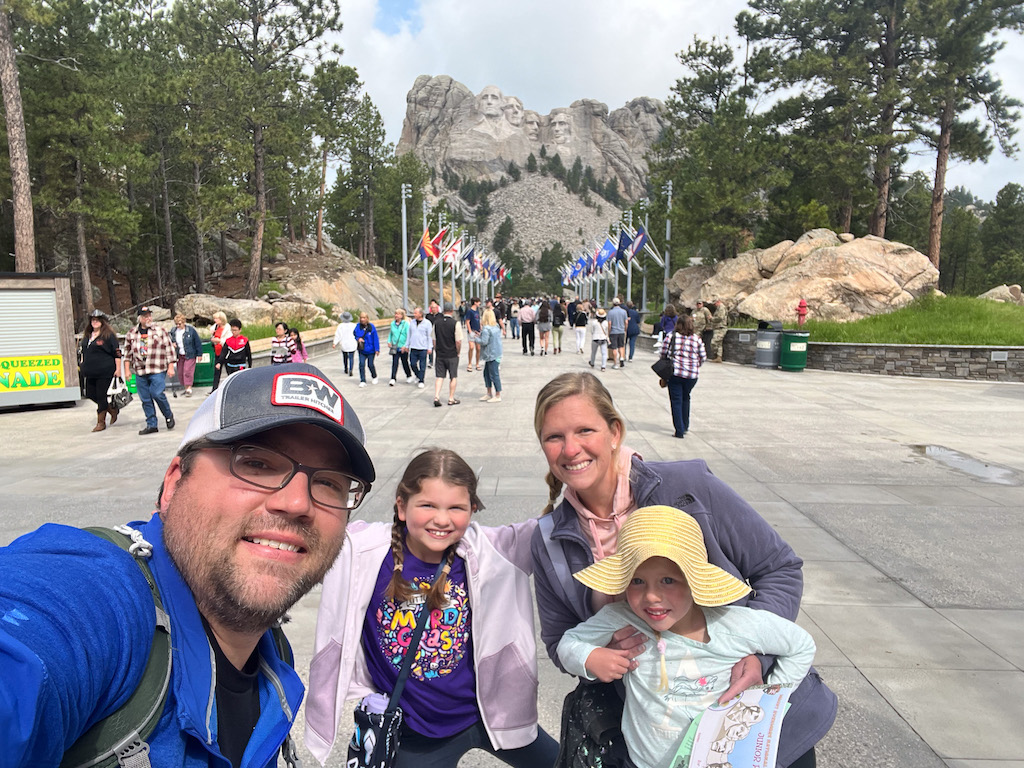
Our oldest daughter was in school, learning about American history, working through the kind of curriculum that covers monuments and Presidents and things that feel abstract when you’re a kid reading about them in a textbook. Mount Rushmore was one of those things. She’d seen the pictures. She knew the facts. It was a thing that existed in the world the way a lot of history exists for kids – real, but distant.
We happened to be traveling through South Dakota at the same time. So we went.
She stood there and looked at it. Not a photo of it. Not a video. The actual thing, carved into an actual mountain, in a way that you genuinely cannot understand until you’re standing in front of it. She asked questions. She made connections between what she’d been learning and what she was seeing.
Something clicked for her in the way things only click when they become real.
When she went back to her class and her teacher brought up Mount Rushmore again, she wasn’t just a student who’d read about it. She was the kid who’d been there. She could describe what it felt like to stand at the base of it. She could tell her classmates things that aren’t in the textbook. That experience became part of how she understood the world.
That moment existed because we were on the road at the exact right time in her life. The overlap between what she was learning and where we happened to be was not something we planned precisely – it was something that happened because we were moving through the world instead of waiting to start.
If we had been waiting for fuel prices to settle down, that overlap never happens. She’s a year older, the lesson has moved on, and that particular version of that experience, the one where it connected to something live in her brain, is simply gone. You don’t get a refund on that. You don’t get a do-over because conditions eventually improved.
That’s what we mean when we say the cost of waiting is real. It doesn’t show up on a fuel receipt. But it’s there.
Follow Us on Instagram!
Kids Don’t Stay the Same Age
This is the thing that hits hardest when you’ve been doing this for a while. Your kids are a specific age right now. They have a specific way of experiencing the world right now, a specific sense of wonder, a specific set of things they’re curious about, a specific capacity for adventure that will shift and change and eventually look very different as they grow.
The National Park that would blow their mind this summer might feel ordinary to a teenager in five years. The road trip that would be the adventure of a lifetime at their current age might get an eye roll when they’re older and would rather be with their friends. We’re not being pessimistic about that, it’s just what growing up looks like. The window for certain kinds of experiences is genuinely time-limited in a way that has nothing to do with fuel prices.
We’ve seen it in our own kids. The way they engage with new places, new people, new experiences on the road has shaped them in ways we couldn’t have manufactured at home. They are more adaptable, more curious, more comfortable with uncertainty than most kids their age. That doesn’t happen by accident and it doesn’t happen by waiting for the right time. It happens by going.
Travel with kids is also just different when they’re young. There is a specific kind of magic in experiencing something big through the eyes of a child, in watching them see the ocean for the first time, or understand the scale of a mountain, or ask a question about history while standing in the place where it happened. That is one of the great privileges of this life. And it has a clock on it.
The Memories Are What You’re Actually Buying
When you fill up the tank and see the total and feel the sting of it, that number is real. We’re not minimizing it. But zoom out for a second and ask yourself what you’re actually paying for.
You’re not paying for diesel.
You’re paying for the morning your kids woke up in a new state and ran outside to see what the world looked like from a different corner of the country. You’re paying for the dinner where your family sat around the table inside your rig with mountains outside the window and nowhere to be the next morning.
You’re paying for the detours that turned into the best days. You’re paying for the conversations that only happen when you’re unplugged from the routine and actually present with the people you love.
Nobody sits with their family years from now and talks about the fuel prices of 2026. They talk about the trip. They talk about what they saw, what happened, what they felt. The memories are what survive. The pump total does not.
We’ve been doing this long enough to say with complete confidence: the trips we almost didn’t take because the timing felt off are consistently among the ones we’re most grateful for. The moments we almost missed because we were waiting for a better moment, those are the near-misses that would have haunted us. Not because something dramatic would have happened, but because the window would have closed quietly and we’d have never known what was on the other side of it.
This Isn’t “Ignore Your Budget” Advice
We want to be clear about what we’re not saying, because this is important. We are not telling you to throw caution out the window and hit the road regardless of your financial situation. That would be irresponsible advice and it’s not the way we operate.
Financial readiness matters, on the road especially, where unexpected costs are part of the deal and having a cushion is not optional, it’s essential. Your rig will need something eventually. A tire, a repair, a system that decides to stop working at the worst possible moment. You need to be prepared for that reality going in.
What we’re pushing back on is the idea that “costs are high right now” is a reason to wait for people who are otherwise ready. Because costs are always something. They were something when we started during a pandemic. They were something when fuel spiked. They are something now. They will be something different in a year or two. The specific shape of the financial concern changes. The pattern does not.
If you are financially ready and the thing holding you back is that travel feels expensive right now, it probably felt expensive last year too, and it will feel expensive next year. That calculation does not resolve itself by waiting. What it does is take time off the clock.
How to Travel Smarter Without Waiting to Travel
If you’re committed to making this work financially, here are the levers that actually move the needle for full-timers and frequent travelers:
Slow down your pace.
This is the biggest one. Moving every two or three days is expensive. Moving every week or two is much more manageable. You also get more out of each place when you actually have time to settle into it rather than spending your first day figuring out where everything is and your second day packing up to leave.
Invest in a camping membership.
Programs like Thousand Trails can significantly reduce your nightly campground costs if you use them consistently. The math works out quickly if you’re on the road regularly. This is one of the most effective ways to reduce your ongoing costs without changing where you go.
Use fuel discount programs.
If you’re towing with a diesel truck, a program like TSD Logistics can save you meaningful money at the pump over the course of a long trip or a full season. It’s one of those things that feels like a small detail until you run the numbers.
Plan your routes with fuel in mind.
Not every fill-up location is created equal. Apps that track diesel prices along your route can help you avoid the most expensive stops. A little planning here adds up over time without requiring you to change your destinations.
Cook in the rig.
Eating out on the road adds up faster than almost anything else. A well-stocked kitchen in your RV and a habit of cooking most meals will save you more than you might expect and honestly, some of the best meals we’ve had on the road have been inside our rig with a view out the window that no restaurant could compete with.
None of these things require you to wait. They’re just smarter ways to go.
You Won’t Get This Time Back
We started this journey during one of the most uncertain moments in recent memory. We kept going when fuel prices made every fill-up a gut punch. We’re still going now. And looking back across all of it, the through-line is simple: the times we chose to go are the ones we’re grateful for. The times we almost let hesitation win are the near-misses we don’t like to think about too long.
Your kids are a specific age right now. You have a specific amount of time and energy and health right now. The places you want to see are there right now. Fuel prices are a line item in a budget. This season of your life is not.
There will always be a reason not to go if you’re looking for one. The pandemic was a reason. Fuel was a reason. Whatever comes next will be a reason. At some point you have to decide whether you’re going to let the reasons run your life or whether you’re going to go make the memories anyway.
Our oldest daughter stood in front of Mount Rushmore while it was still fresh in her mind from school. She got to tell her classmates about it from experience, not from a picture. That happened because we went. It cost us money to get there. It cost us nothing compared to what it would have cost us to miss it.
The memories are what you’re actually buying. They last a lot longer than the fuel receipt.
If you’re thinking about getting into RV life and want to talk through what it actually looks like, the real costs, the real logistics, and how to set yourself up to do it well from the start, that’s exactly what we help people with.

Written By: Chris & Amanda Stocker (Type1Detour)
Full-time RVers traveling the country in our Alliance Valor.