When you start shopping for an RV for your family, every brand will tell you they have the perfect layout. Every YouTuber will swear by a different floorplan. Every Facebook group will insist, “Just get a bunkhouse. You’ll be fine.”
But here’s the truth:
The best RV layout for your family depends on how you actually live or camp in it and not how it looks in a brochure.
We’re a family of four who has spent the last 4.5 years living full-time on the road.
We’ve traveled coast to coast, visited national parks, homeschooled from our kitchen table, cooked over a thousand meals in a tiny kitchen, survived rainy days in 300 sq ft, and learned exactly what matters (and what absolutely does not).
TABLE OF CONTENTS
Dedicated Sleeping Spaces for the Kids
A Separation Between Adult Space & Kid Space
Real Storage Capacity (Not Just Pretty Cabinets)
Bathroom Accessibility (Especially on Travel Days)
A Workspace (Even If It’s Small)
Safe Towing & Weight Considerations
Outdoor Storage for Toys, Bikes & Gear
The 5 Best RV Layouts for Families (Honest Pros & Cons)
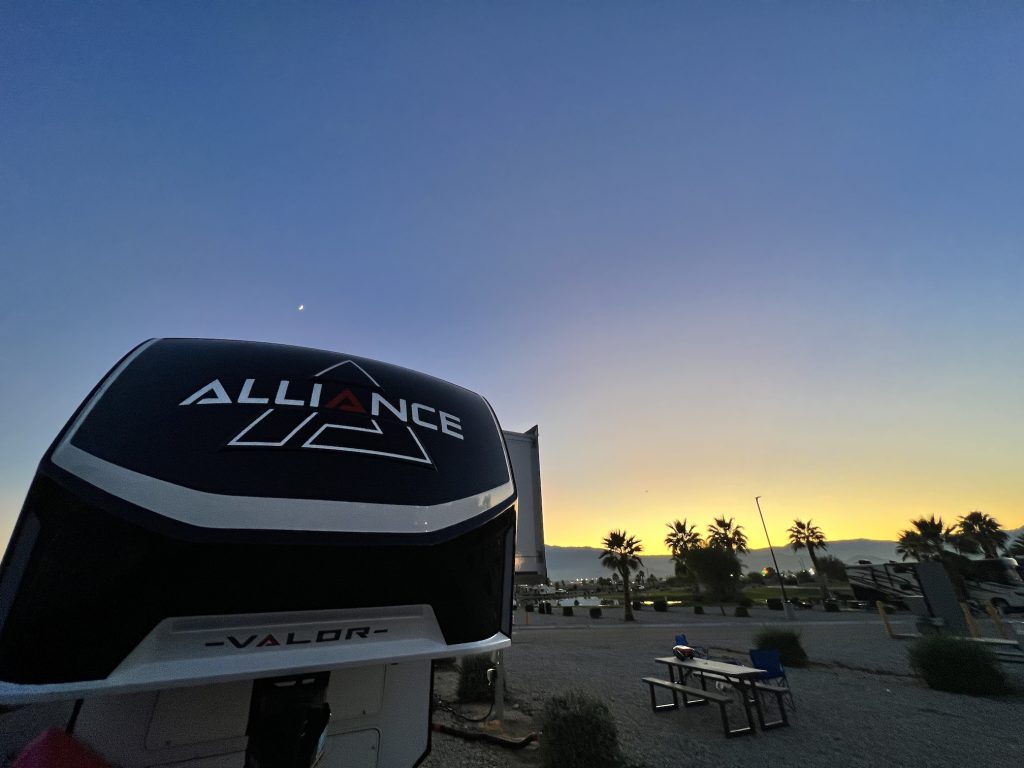
Why We Chose an Alliance Valor Toyhauler
How to Choose the Right Layout for Your Family (Checklist)
Final Thoughts: What 4 Years on the Road Taught Us About RV Layouts
Our Real-World Criteria After 4 Years of Full-Time RV Living
Everyone tells you to “just pick what feels right.” But after living in two different RVs full-time, we realized something:
Without clear criteria, you’ll almost always regret your layout.
Here are the criteria we personally use and why they matter.
1 – Dedicated Sleeping Spaces for the Kids
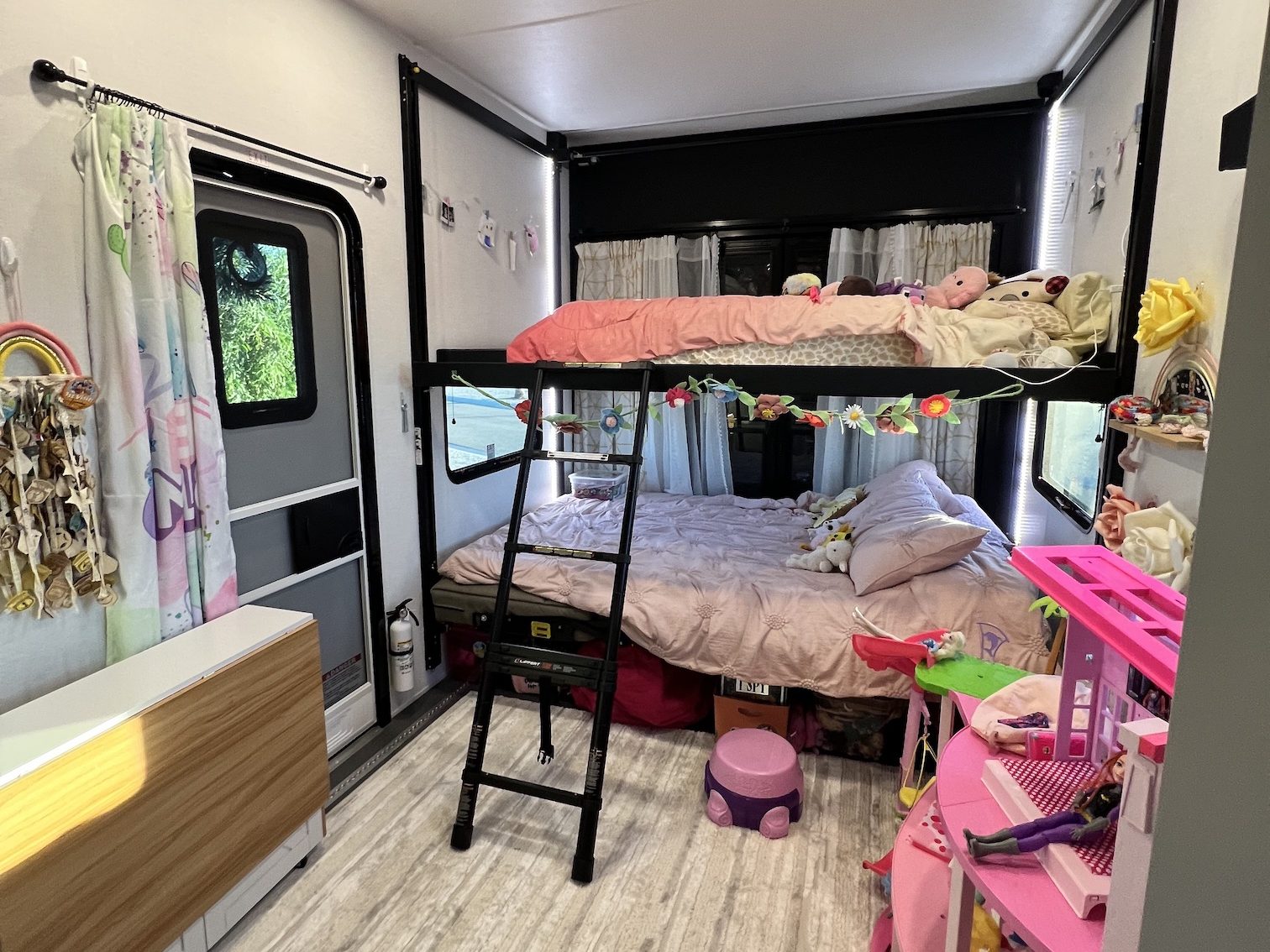
If you’ve ever converted a dinette into a bed every single night, you already know that tear-down beds = guaranteed burnout.
We’ve always believed that our kids needed a real bedroom space in the RV. Giving them a real mattress has made a huge difference in their sleep, comfort, and overall attitude on the road. When you’re full-timing, good sleep isn’t optional.
For people who are weekend campers, this may not be as big of a criteria for you because the dinette turned bed is only used for a couple of nights and sleep. This makes it a great option for those that are not utilizing the RV as their home.
We also wanted them to have a space that truly felt like theirs. Not shared. Not temporary. A place where they could keep their belongings, decorate a little, and feel settled even when everything around them changes. That sense of ownership goes a long way for kids who live in a home on wheels.
Clothing and toy storage became just as important. Even in an RV, kids still come with stuff and lots of it! Without designated storage, their stuff end up spread across the entire living area. Having real drawers, shelves, or cubbies gives them responsibility over their things and keeps the rest of the RV from turning into a toy explosion zone.
And finally, we learned quickly how important privacy is. Whether it’s a sliding door, a curtain, or a full bunkroom with an actual door, giving kids a little separation helps with bedtime routines, early mornings, and the occasional moment when everyone needs their own space. It also gives adults the ability to talk, work, and decompress after the kids go to bed without tip-toeing around in total silence.
For us, we try to keep as much routine as possible, so if your kids have beds that don’t get disturbed daily, everything runs smoother, like bedtime, mornings, homeschooling, all of it.
2 – A Separation Between Adult Space & Kid Space
We don’t want this for aesthetics, but for sanity.
As much as RV life revolves around family time, we quickly realized that adults need their own space, too. For us, it starts early in the morning by having a quiet spot to drink coffee before the kids wake up. This sets the tone for the entire day.
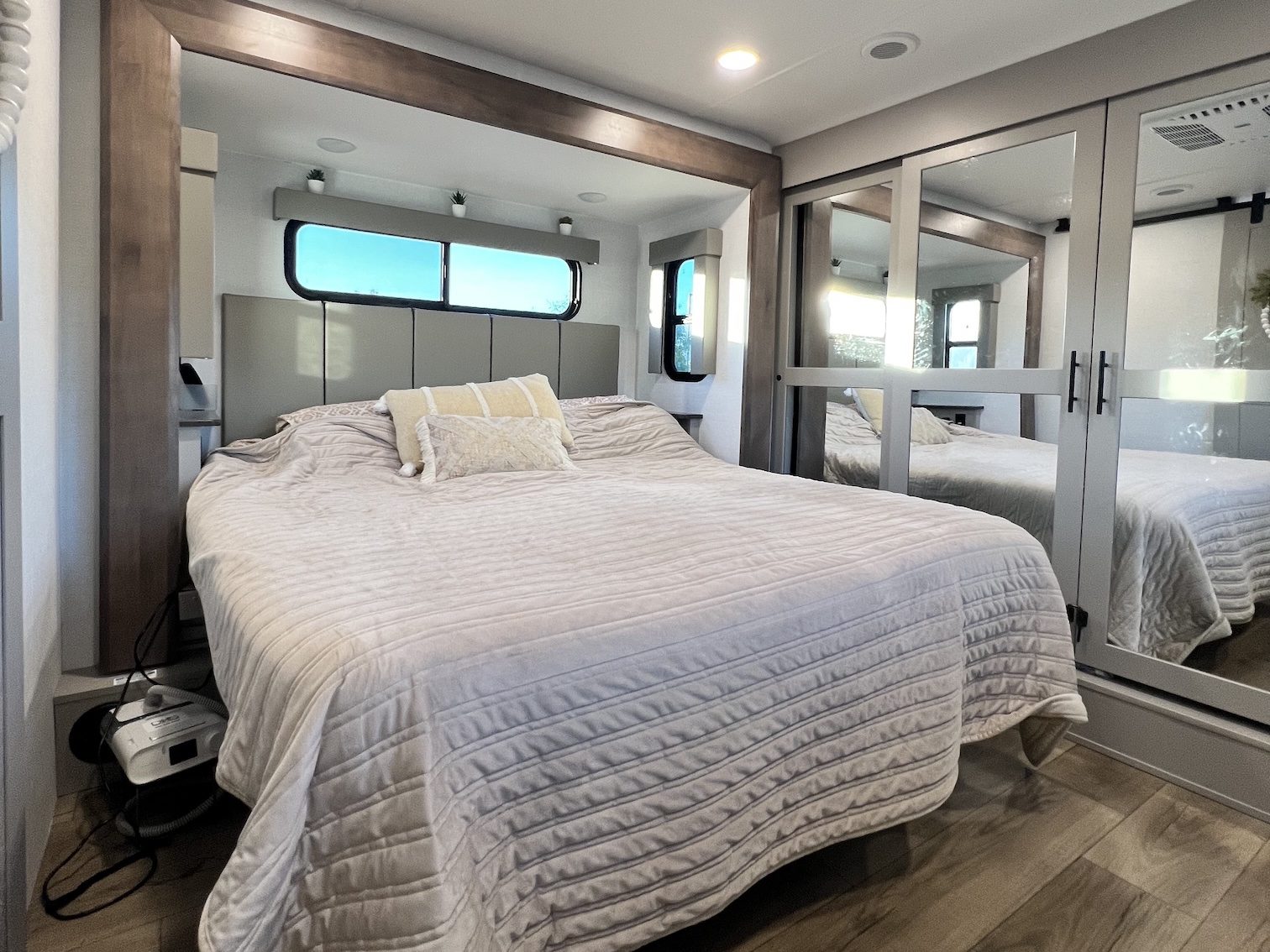
Those few peaceful minutes make a huge difference when the rest of the day is full of schoolwork, travel days, and the usual kid chaos.
At night, that separation becomes just as important. After the kids go to bed, we like to unwind by watching a show, catching up on our favorite YouTube channels, or simply having a conversation that doesn’t involve snack requests. Having a dedicated adult space makes evenings feel like a real break, even in 300 square feet.
And then there’s work. Whether it’s editing videos, answering emails, writing another blog post or planning the next part of our trip, we sometimes need to focus without Bluey blasting in the background. A layout that offers even a little separation between kid space and adult space makes it far easier to stay productive and sane on the road.
Layouts with bunkrooms, mid-bunks, or toyhauler garage conversions make this possible.
3 – Real Storage Capacity (Not Just Pretty Cabinets)
RV brochures love oversized cabinets that aren’t actually usable.
As a family, storage becomes one of the most important parts of RV living and it’s usually the thing people underestimate the most.
A true pantry is essential.
When you’re feeding multiple people every day, tiny cabinets just don’t cut it. Having a real pantry means fewer grocery runs, easier meal prep, and way less frustration when trying to find the snacks your kids insist they didn’t already eat.
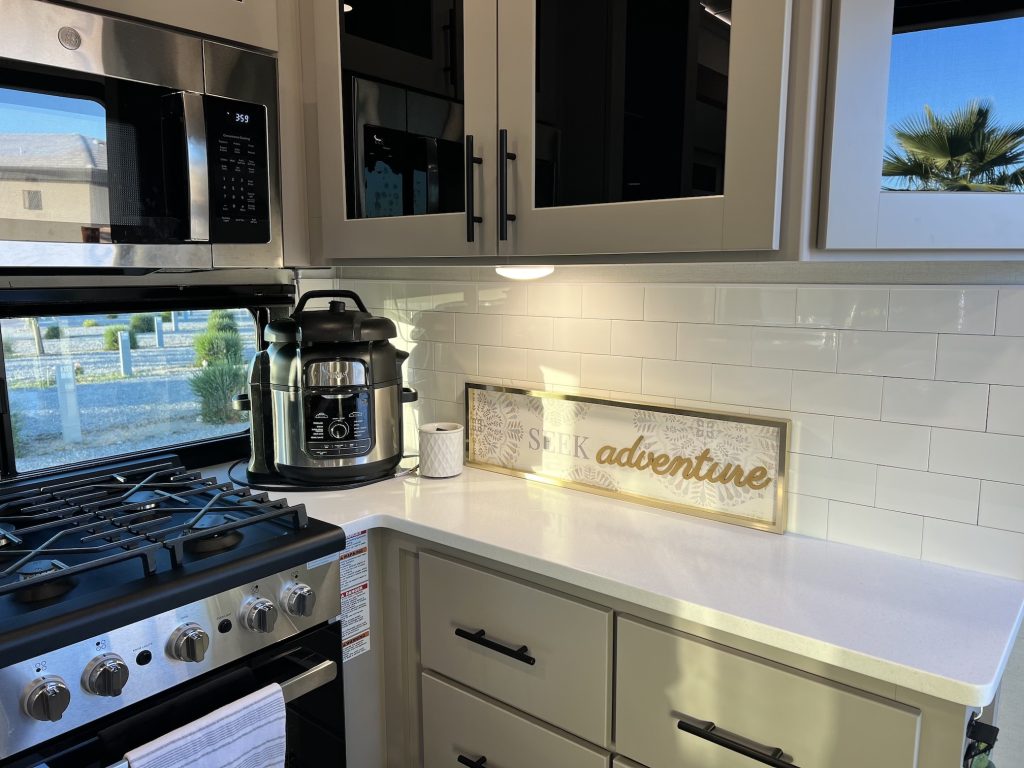
Clothing space is another big one. Four people (or more) come with a surprising amount of clothes, jackets, pajamas, shoes, and seasonal layers. Without enough storage, clothes start piling up in corners, baskets, and anywhere they can fit. A layout that includes usable drawers, wardrobes, or shelves makes day-to-day life feel organized instead of chaotic.
If you homeschool or roadschool like we do, you’ll need dedicated space for books, laptops, workbooks, art supplies, and everything else that travels with you. These items take up more space than people realize, so having a layout with intentional storage makes school days smoother and keeps materials from cluttering every countertop.
And then there’s the outdoor camping gear like scooters, bikes, helmets, folding chairs, sports equipment, and all the things kids love. Without outdoor storage, these items end up inside the RV or scattered around the campsite. A pass-through compartment or toy hauler garage can make all the difference when it comes to staying organized on the road.
If a layout doesn’t have storage, it will feel “too small” no matter how pretty it is. An RV is already small enough, so as soon as things do not have a proper place, it will feel cluttered and even smaller.
4 – A Functional Kitchen Layout
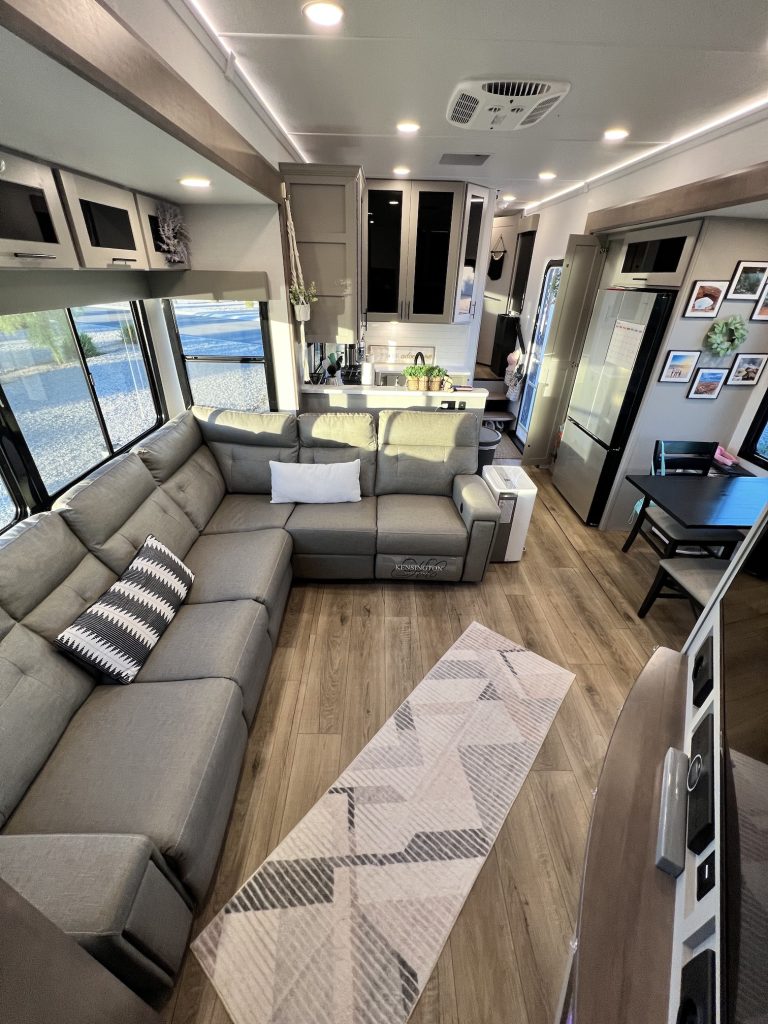
There are several different RV kitchen layouts and they all have their own unique pros and cons.
A few examples of kitchen layouts are, U-shaped, island, front kitchen and rear kitchen.
In our first RV that we owned for over 4.5 years, we had a kitchen island which meant that the kitchen was open to the living room and dining room and was just one large flowing room.
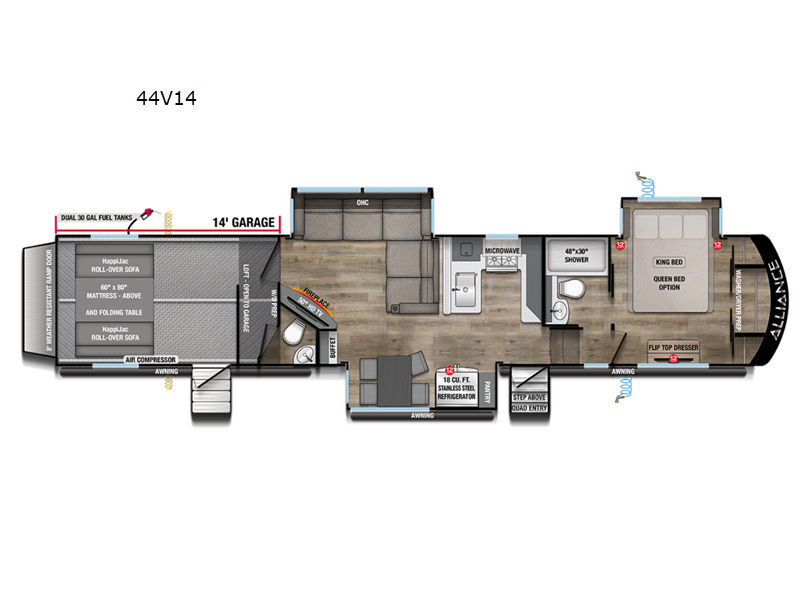
Our current RV, a 2026 Alliance Valor 44V14, has a U-shaped kitchen which creates a dedicated separation between kitchen and living room.
Other things to consider when looking at RV floorplans and layouts are the small, day-to-day details that make a huge difference in how livable the space feels. Countertop space, for example, becomes incredibly important, especially when you’re cooking for a family. Having enough room to prep meals without balancing cutting boards on top of the stove can make cooking in an RV feel much less stressful.
You’ll also want to think about whether there’s enough space for you to cook while other people walk by. Kids, pets, and partners tend to move through the kitchen constantly, and a cramped layout can make meal prep feel chaotic. A good floorplan gives everyone room to move without bumping into each other every time someone needs a snack.
And finally, pay close attention to what appliances you can access when the slides are closed. Many RVs look spacious with the slides out, but if you can’t reach the fridge, stove, or microwave on travel days, you will feel the frustration quickly. Being able to grab snacks, make lunch, or heat something up at a rest stop without opening the slides makes travel days far easier.
5 – Bathroom Accessibility (Especially on Travel Days)
This one is overlooked…… until it’s not.
One of the perks of traveling with an RV is that you are taking an extension of your home or your actual home with you. That means that you have your own beds and your own bathrooms, so on travel days, it is great to be able to access a toilet in case you need to stop off somewhere.
You may also want to be able to access a bedroom so that you can take a nap or be able to spend the night somewhere without having to put slides out.
Some layouts block every essential thing when slides are in.
Huge mistake.
You also want to be sure that you can actually USE the toilet and shower in the bathroom as well. Make sure everyone fits and is not bumping into doors, cabinets and especially those pesky glass shower RV doors!
6 – A Workspace (Even If It’s Small)
This may be something that is not needed for you. If you are weekend camping and using your RV to escape work and relax, then a workspace consideration is not one you need to make.
But also, congrats on getting out there on the weekends!
When you’re living and traveling with kids, the reality is that your RV has to function as more than just a home. It becomes a classroom for homeschool, an office for remote work, and a play space for rainy day activities.
Trying to squeeze all of that into one shared table quickly becomes a problem. If everyone is using the same space for everything, that table gets worn out and so do you.
That’s why having a dedicated workspace makes such a big difference. A mid-bunk room with a door can transform into a quiet study or work area when you need it. A garage in a toy hauler can double as an office, a craft room, or a playroom depending on the day. Even a small coffee bar that doubles as a desk can give you enough separation to work without disrupting the rest of the RV.
A layout that includes even one flexible workspace makes everyday life far easier for families who live, learn, and earn on the road.
7 – Safe Towing & Weight Considerations
Families often fall in love with a layout based purely on the floorplan without fully considering what it will take to tow it.
When we purchased a truck, we decided to get a dually so that we could always upgrade our RV if we wanted to, and not have to worry about upgrading a truck later on also.
If your truck isn’t the right match for the weight and size of your rig, nothing about the layout will fix that. Every travel day becomes stressful, every climb feels overwhelming, and the entire experience becomes harder than it needs to be.
It is always important for you to figure out how much your truck can tow, but also more importantly, can your truck stop the RV if needed?
Choosing a layout that fits your lifestyle and your towing setup is absolutely essential.
8 – Outdoor Storage for Toys, Bikes & Gear
Kids bring toys and lots of them. And scooters. And helmets. And all kinds of sports gear that somehow takes up more space than you expect. The reality is that not every RV layout offers true pass-through or garage-style storage to handle all of that.
But the ones that do?
They’re absolute game-changers for families. Having a dedicated space to store all the outdoor gear keeps the RV cleaner, the kids happier, and travel days far more organized.
9 – Room for Rainy Days
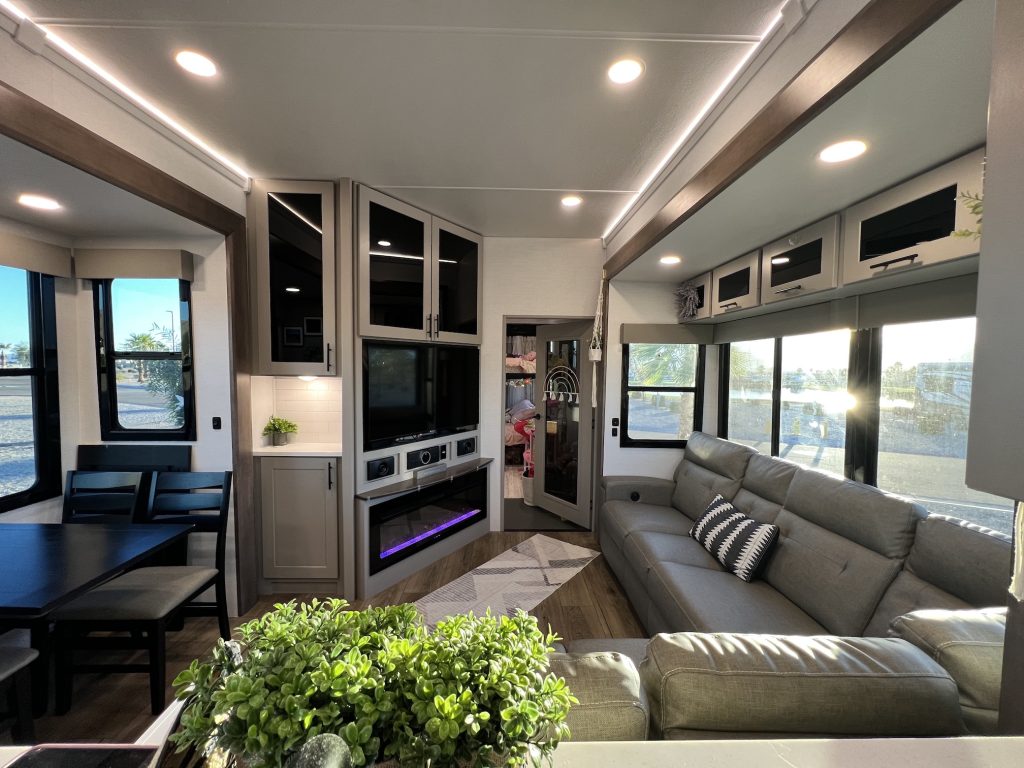
You need a living space that can handle more than just day-to-day life. On the road, your RV becomes the place where toys get played with, where everyone lounges on slow mornings, where schoolwork happens, and where you gather for movie nights as a family.
All of those activities require space, flexibility, and room to breathe. If the living area feels tight or cramped, rainy days quickly turn into chaos. A layout with enough room for everyone to spread out makes all the difference when the weather forces you indoors.
Follow Us on Instagram!
The 5 Best RV Layouts for Families (Honest Pros & Cons)
After traveling full-time and seeing hundreds of setups, these are the layouts we consistently recommend, along with who they’re best for.
Bunkhouse Travel Trailers
If you’re dipping your toes into RV life, this is where most families start and it works for many.
| PROS | CONS |
| Lightweight | Limited storage |
| Affordable | Smaller bunks |
| Simple for beginners | Tighter living space |
| Enough space for short trips | Not ideal for long-term full-time use however, plenty of people still can do it |
Rear Bunkhouse Fifth Wheels
These are often ideal for families with younger or mid-aged kids.
| PROS | CONS |
| Huge bunkrooms | Typically requires a heavy-duty truck |
| Great living areas | Higher cost |
| Large kitchens | Bigger footprint |
| More privacy for kids |
Mid-Bunk Fifth Wheels
These can be great with families with one kid or even young children who can share the space.
| PROS | CONS |
| Dedicated mid-bunk room with door | Mid-bunk rooms vary drastically by brand |
| Extra loft space | Still requires a larger tow vehicle |
| Truly residential layouts (front living room areas) | Higher price point |
| Amazing storage | |
| Great combination of living + working + sleeping |
Toy Haulers
Toy haulers are incredibly flexible for families because it can be a kids room, play room or even converted into the parent’s bedroom and office. (This is our favorite choice!)
| PROS | CONS |
| Garage = kids’ room, playroom, office, guest room | Garage beds may not be ideal for very young kids |
| Perfect for bikes, scooters, kayaks | Heavier |
| Excellent storage | Garage area typically not heated or cooled as well as the rest of the RV |
| Strong build for full-timers | Less kitchen/living space in some models |
Class A or Class C Motorhome with Bunks
Perfect for fast-moving roadtrip families, national park explorers, frequent movers.
| PROS | CONS |
| Easy to travel in | Limited storage |
| Bunks available without slides | Less privacy |
| Great for quick trips | Not ideal for long-term full-time living, however many families make it work. |
Why We Chose an Alliance Valor Toyhauler
We spent the first 4.5 years of full-time RV living in a fifth wheel bunkhouse. It had 2 showers and 2 bedroom areas, so it fit us great. However, after all that time, we outgrew it and it was time to move on to something bigger and Alliance RV stood out to us.
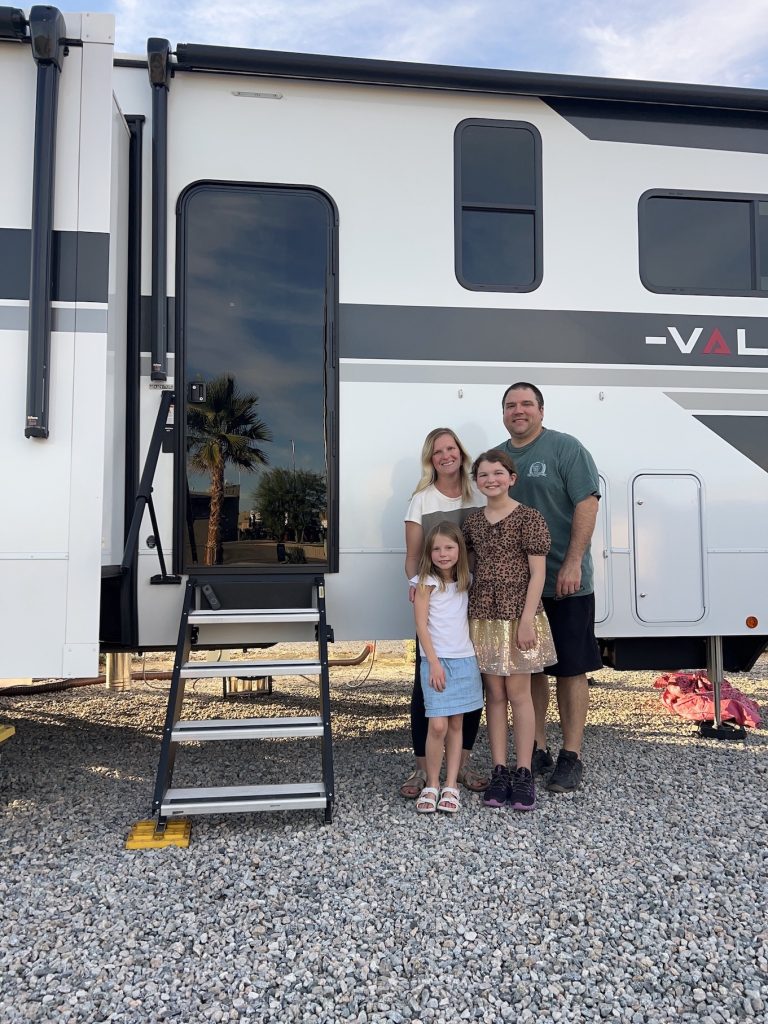
What Alliance Does Well:
- Thoughtful mid-bunk + bunkhouse layouts + smart toyhauler layouts
- Strong insulation for full-time travel
- Residential-style storage
- Durable construction for everyday use
- Customer-focused support
- Floorplans that make sense for families
Potential Cons to Be Transparent About:
- Higher price point
- Some models are heavier and require bigger trucks
- Limited dealer availability in certain regions (don’t worry, we have EXCLUSIVE pricing through Bish’s RV and a way to get one to you!)
But overall?
Alliance is one of the top brands we consistently recommend, especially for families since we know that dynamic the best!
How to Choose the Right Layout for Your Family (Checklist)
Bring this checklist with you to the RV dealership:
✔ Can everyone sleep comfortably without converting furniture?
✔ Can we access the bathroom with slides closed?
✔ Is there a space for work or homeschool?
✔ How much pantry storage is there?
✔ Where do toys, scooters, and gear go?
✔ Do we need a door between kid space + adult space?
✔ Can our current truck safely tow this?
✔ Does this layout still work on rainy days?
✔ Can the kitchen actually be used with people walking through?
✔ Is there a spot for laundry baskets, shoes, and backpacks?
If a layout checks 80% of these boxes, it’s worth serious consideration.
Final Thoughts: What 4 Years on the Road Taught Us About RV Layouts
If we’ve learned anything in our full-time journey, it’s this:
You’re not choosing an RV layout.
You’re choosing a lifestyle flow.
The right layout makes everyday life easier. The wrong layout makes every day feel like a struggle.
There’s no perfect RV, but with the right criteria, and an honest look at how your family actually lives, you can find the layout that truly feels like home.
And if you’re overwhelmed or unsure, we’re always happy to help guide you. After four years on the road, we’ve seen what works… and what absolutely doesn’t.

Written By: Chris & Amanda Stocker (Type1Detour)
Full-time RVers traveling the country in our Alliance Valor.