
Lithium RV batteries have become a common topic in the RV world, especially as more rigs begin offering them as an option. They store energy differently than traditional lead-acid batteries, can be used to a deeper discharge level, and handle charging in their own unique way.
For RVers who are simply trying to understand what lithium is, how it works, and where it fits into camping life, a basic overview can make the whole topic much easier to navigate.
Table of Contents
What is a Lithium Battery
Lithium vs Lead Acid
Weight Savings and Cargo Capacity
Storing Lithium Batteries
How Long Do Lithium Batteries Last
Lithium Costs
Charging Lithium
Cold Weather and Lithium
Safety and Lithium
Step-by-step Upgrade
Final Thoughts on Lithium
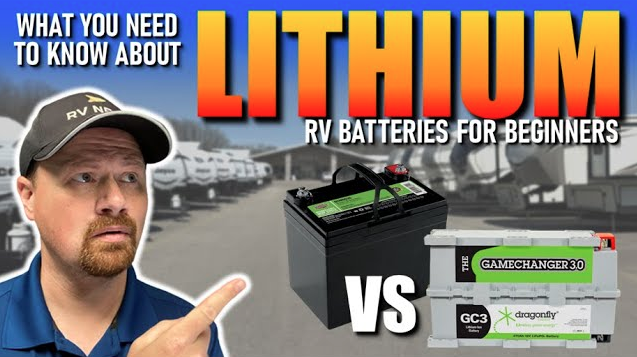
What Is a Lithium RV Battery (and Why Is Everyone Talking About It)?
For decades, RVs relied on flooded lead-acid batteries – basically the same technology as a car battery. They work, they’re cheap, and they’ve been the standard “house” battery in most campers.
A lithium RV battery (usually LiFePO₄ chemistry) is a newer battery type that:
- Stores more usable power in the same or smaller size
- Weighs much less
- Can be safely discharged deeper
- Charges faster and usually lasts far longer
This isn’t a deep dive in electrical engineering, it’s a “regular person’s guide” to the real-world pros and cons so you can decide if lithium is overkill, a game changer, or maybe something to plan for later.
Lithium vs Lead Acid: Capacity, Usable Power & Performance
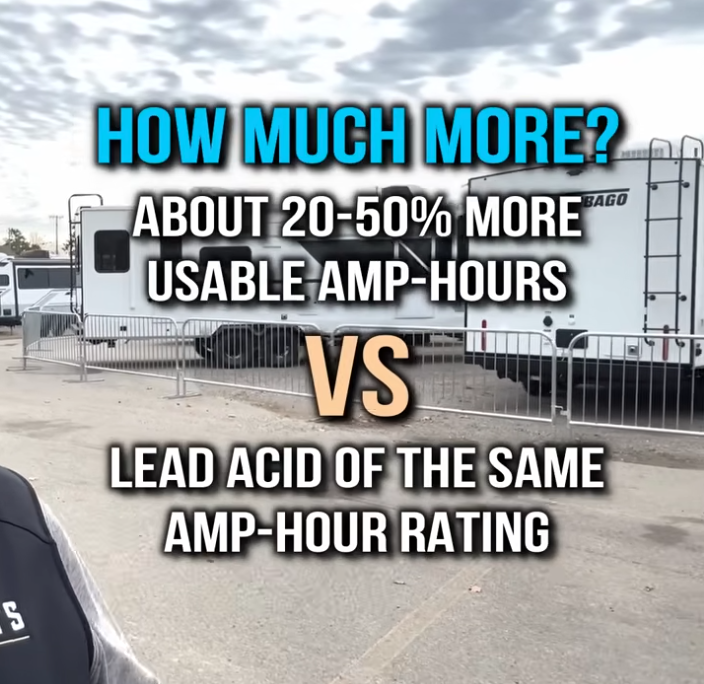
Think of your battery like a gas tank.
- With lead acid, you might have “50 gallons” on paper, but you’re only allowed to use about half before you start damaging it.
- With lithium, you get a bigger tank, plus you can safely use most of it.
Amp Hours vs Usable Power
Batteries are rated in amp hours (Ah).
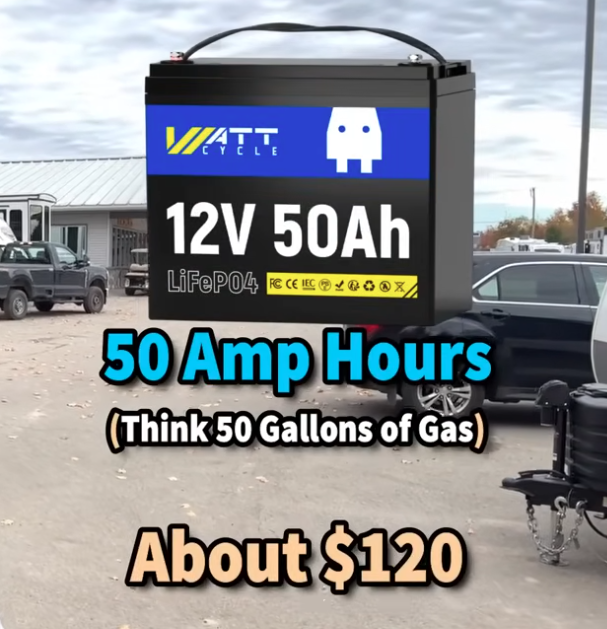
- A typical lead-acid RV battery might be rated at 50 Ah.
- In reality, you should only use about 50% of that (25 Ah) to avoid damage.
- As a lead-acid battery drains, its voltage and power output sag, so your lights dim and your performance drops.
Lithium flips that on its head:
- You can often use up to ~90% of a lithium battery’s capacity.
- It provides a steady, even power output almost all the way down.
- When it’s empty and you recharge it, it usually comes back to full capacity without losing “tank size” like a lead-acid battery does over time.
So even if a lithium and a lead-acid are both rated for similar amp hours on paper, the usable power from lithium is dramatically higher. That’s why lithium is such a big deal for:
- Boondocking / off-grid camping
- Running lots of 12V loads, inverters, and 12V fridges
- People who camp away from hookups frequently and for longer stretches
Weight Savings & Cargo Capacity (Why Lithium Helps Your GVWR)
RVs are getting heavier. Every model year, a lot of floorplans gain a little weight, but the GVWR (max weight rating) doesn’t always change. That slowly eats into your cargo capacity.
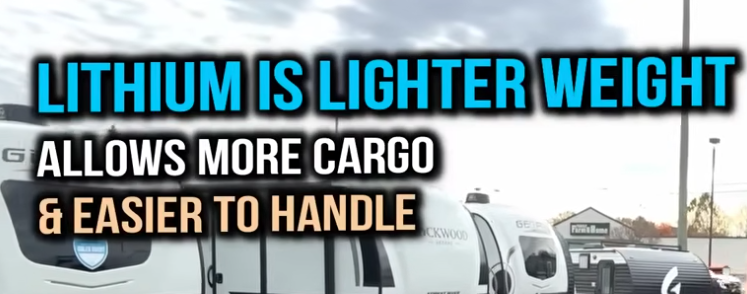
Lithium can help claw some of that back.
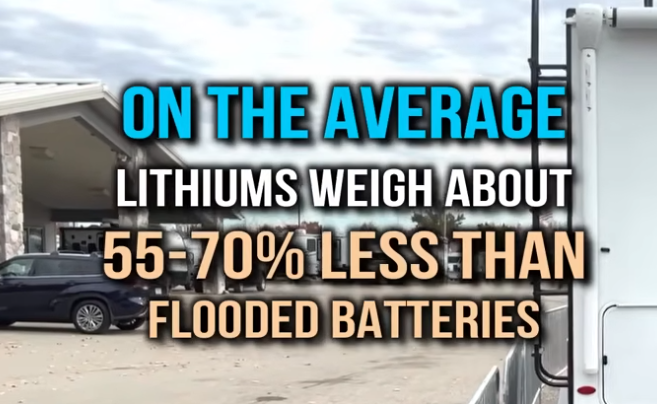
- On average, at equivalent amp hour ratings, a lithium battery can weigh about 55–70% less than a comparable flooded lead-acid.
- Less battery weight = more CCC (cargo carrying capacity) for:
- Water
- Gear
- Food
- Toys in a toy hauler
If your trailer already rides close to its max weight, dropping battery weight can take a little stress off:
- Suspension
- Brakes
- Tires
- Frame components
Every pound counts when you’re flirting with GVWR.
Storing Lithium Batteries Inside Your RV (and Theft Protection)
Flooded lead-acid batteries off-gas and must be mounted in a ventilated area, which is why:
- They’re usually on the tongue of a travel trailer or
- In a vented compartment on a fifth wheel
Lithium batteries don’t have that same off-gassing issue, so they can safely be stored inside the RV’s body – for instance, in an interior storage compartment.
Why this matters:
- You can hide an expensive lithium battery inside the RV instead of leaving it out on the tongue where it’s easy to steal.
- It gives you more flexibility in layout and protection.
However, most RVs are still wired assuming the battery will live outside. That means:
- The factory battery cables run to an exterior location
- If you want to move the lithium battery inside, you may have to reroute wiring
Not a massive project, but it’s an extra step most owners don’t think about until they’re mid-upgrade.
How Long Do Lithium RV Batteries Last?
If you treat them right, lithium batteries can last many times longer than flooded lead-acid.
- Many RVers replace lead-acid batteries every 1–3 years, often because they were accidentally over-discharged.
- Properly used lithium batteries are often rated for thousands of cycles, which can translate to:
- 8–10 years, sometimes more
- Some manufacturers even claim up to ~15 years under the right conditions
Over a decade of ownership, one good lithium battery may cost less than multiple lead-acid replacements, even if it’s more expensive up front.
The Real Costs: Upfront Price, Chargers & Extra Gear
Here’s where things get real.
Upfront Battery Cost
- A flooded lead-acid battery is inexpensive.
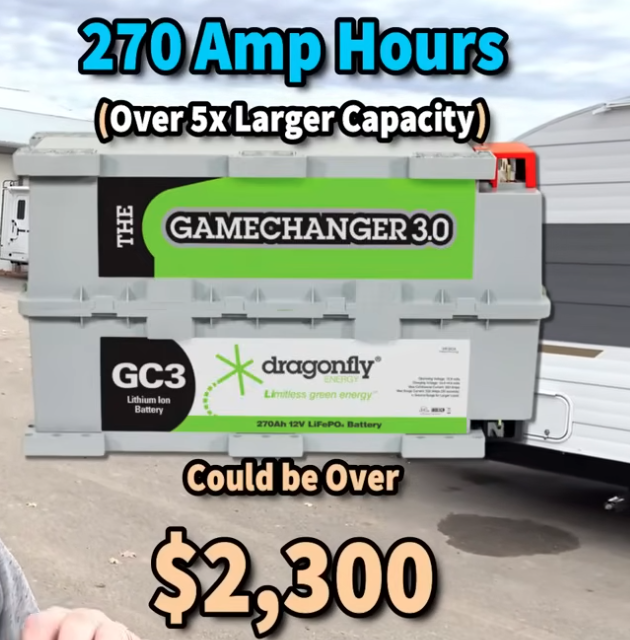
- A lithium battery with decent capacity can be hundreds of dollars, and bigger units can easily land in the $1,000+ range.
- If you want more capacity (multiple batteries), that cost multiplies quickly.
Hidden Costs Beyond the Battery
You may also need:
- A proper lithium-compatible converter/charger
- Possibly upgraded wiring
- A DC–DC charger between your tow vehicle and RV
- Professional installation labor, which is not cheap in any RV service bay
By the time you add a battery, DC–DC charger, and labor, you can easily tack on $500 or more on top of the lithium cost itself.
That’s why it’s important to think in terms of total cost of ownership, not just the price tag on the battery box.
Charging Lithium the Right Way (Converters, Tow Vehicles & DC–DC Chargers)
Lithium batteries are a little “greedy” – in a good way. They:
- Want to pull more juice, faster
- Need the right voltage and charging profile to reach a full charge and stay healthy
RV Converter Issues
Most older RVs, and many budget-friendly models, came with converters designed for lead-acid batteries.
- Some newer rigs use “auto-detect” converters that can sort of work with lithium – but often they:
- Only charge the battery to around 80%
- Don’t follow an ideal lithium charging profile
That means you might never fully top off your expensive new battery unless you:
- Upgrade your converter to a lithium-specific model, or
- Supplement with solar (properly set up for lithium), or both
Tow Vehicle Charging & DC–DC Chargers
If your tow vehicle has a 12V charge line that sends power back to the RV when you’re plugged into the 7-way, then your:
- Truck battery system and
- RV battery system
If you pair a lithium RV battery with a standard lead-acid vehicle battery without anything in between, they try to “mirror” each other. That mismatch can:
- Overwork your alternator
- Stress your truck’s electrical system
- Cause charging problems on both sides
That’s why a DC–DC charger is so important in a lithium upgrade:
- It sits between the vehicle and RV batteries
- It ensures they “play nice” and don’t damage each other
- It provides a proper charge profile to the lithium battery while protecting the vehicle’s system
A DC–DC charger usually runs $150–$300, plus installation.
Cold Weather & Lithium: What You Need to Know Before Winter

Lithium batteries are picky about charging temperature.
- Discharging (using power) is usually fine in almost any temperature an RVer will reasonably face.
- Charging is where it gets tricky:
- It can be too hot to charge safely.
- More commonly for RVers, it can be too cold.
Many lithium batteries:
- Will refuse to charge below ~32°F (0°C) to avoid damage.
- Include internal heating elements that warm the battery before charging.
But those heaters:
- Use the battery’s own power to heat it up.
- Can potentially drain the battery enough that it never reaches the temperature needed to start charging, especially during deep winter storage.
Best practice for cold climates:
- Remove your lithium battery from the RV for winter storage.
- Store it somewhere around 60–80°F for minimal passive loss and longest life.
- If your RV has solar, cover the solar panel or flip the solar disconnect so your charge controller isn’t randomly activated in freezing temps and burning itself out after the warranty ends.
Safety: Are Lithium RV Batteries Really Safe?
Both battery types have different safety risks.
Lead Acid Safety
Pros:
- Generally considered less dramatic in a fire scenario.
- If they fail, the event is usually more contained.
Cons:
- Constant off-gassing – must be ventilated.
- Acid can spill, cause corrosion and damage surfaces.
- Storing one indoors (like in a coat closet – Josh’s dad, we’re looking at you) is a bad idea.
Lithium Safety
Pros:
- No everyday off-gassing.
- Can be stored inside living spaces safely.
- Lower risk of leaks or corrosion.
Cons:
- If a lithium battery does go into thermal runaway and catches fire, it can be extremely intense.
- Once it starts, it tends to burn very hot and must largely burn itself out.
Real-world examples: Josh the RV Nerd shares two experiences, an exploding vape pen lithium battery in a hospital waiting room and a total-loss consignment shop fire likely started by a lithium battery. Those aren’t meant to scare you off entirely – just to underline that:
Neither type is perfectly “safe.” Each has different risks you need to understand and respect.
Lithium RV Battery Safety Chart
| Safety Topic | What to Know About Lithium Batteries | What You Should Do as an RVer |
|---|---|---|
| Fire behavior | If a lithium battery goes into thermal runaway, the fire is very hot and hard to extinguish. It must burn itself out. | Buy name-brand batteries, mount them securely, protect them from physical damage, and follow install instructions exactly. |
| Charging below freezing | Most lithium batteries should not be charged below ~32°F (0°C) or they can be damaged. Many will simply refuse to charge when too cold. | In cold climates, keep batteries in a heated space or use batteries with built-in low-temp protection. Don’t try to force charging when it’s below freezing. |
| Built-in heaters | Many RV lithium batteries have internal heaters that warm the battery before charging—using the battery’s own power. | Plan for the extra power draw in cold weather. Don’t let the battery sit nearly empty if you expect freezing temps. |
| Storage temperature | Lithium batteries prefer being stored around 60–80°F and hold a charge better than lead-acid when sitting. | For winter storage, remove the battery and store it in a climate-controlled area when possible. Avoid extreme hot or cold. |
| Ventilation & fumes | Lithium batteries don’t off-gas like flooded lead-acid, so they can be stored inside the RV when properly installed. | If moving a lithium battery inside, make sure wiring and mounting are updated safely—don’t just “set it in a closet.” |
| Charging system compatibility | Many older or budget RV converters and chargers aren’t designed for lithium and may only charge them to ~80%. | Verify your converter has a lithium profile or upgrade to a lithium-compatible charger before swapping batteries. |
| Tow vehicle alternator | A lithium house battery can “pull too hard” from a standard alternator and 12V charge line, risking alternator damage. | Use a DC-to-DC charger between your RV lithium battery and the tow vehicle charge line so the systems “play nice.” |
| Mixing battery types | Lithium and lead-acid batteries behave differently and don’t work well when directly paired together. | Don’t mix lithium with lead-acid in the same bank. If you add batteries, replace the whole bank with matching type/age. |
| Physical damage | Crushed, punctured, or badly damaged lithium batteries can become a serious fire hazard. | Protect batteries from impact, road debris, and improper mounting. Replace any battery that’s been physically compromised. |
| General maintenance | Lithium needs less day-to-day maintenance than flooded lead-acid but still requires regular checks. | Periodically inspect cables, lugs, fuses, and mounting brackets. Keep terminals tight and corrosion-free. |
Step-by-Step Upgrade Path: From Single 12V to Lithium
Josh the RV Nerd recommends a “mental tier list” for battery upgrades:
- Start basic: One standard 12V flooded lead-acid battery
- Add capacity: Two matched 12V lead-acid batteries
- Go bigger: Two 6V flooded batteries in series for more reserve
- Then consider lithium:
- Once you’ve learned your camping style
- After you know how often you’re off-grid
- When you’re sure the cost makes sense for you
Why this order?
Because you might discover along the way that:
- A couple of 6V batteries already meets your needs.
- You don’t actually need a $1,000 lithium battery plus a $500 DC–DC charger and all the extras.
Experiment, gain experience, and let your real-world camping habits guide your investment.
Final Thoughts: Is a Lithium RV Battery Worth It for You?
Lithium RV batteries are:
- Amazing for extended boondocking, solar-heavy setups, and modern 12V-fridge rigs.
- Expensive, especially once you factor in chargers, DC–DC gear, and install.
- Lighter, longer-lasting, and more usable in terms of true capacity than lead-acid.
- Picky about charging temperatures and require proper system matching.
There’s no one-size-fits-all answer. For some RVers, lithium is life-changing. For others, it’s a wallet hit they’ll never fully use.
If you’re unsure, follow Josh’s approach:
- Start simple.
- Add capacity as your camping style demands it.
- Then step into lithium when you’re confident it’s solving a real problem, not just chasing the latest trend.
Making the switch to lithium may be the upgrade you’re looking for! At Bish’s, we’re here to help match the right batteries, solar, and charging gear to your actual travel plans… it’s the kind of conversation we have with RVers every day!

Written By: Brooke Erickson
Some say I am a writer, I like to say I am a storyteller