If you’re wondering “how much can my truck tow?” or “what size truck do I need to pull that trailer?” You’re definitely not alone.
These are super common questions in the RV/trailer world, and we are going to walk you through everything you need to know to answer them for your exact setup, using clear definitions and real-world logic.
Table of Contents
Key Weight Terms
How the Truck and Trailer Interact
What Size Truck Do You Need
Why Half Tons Often Fall Short
Safety and Best Practice Tips
Bottom Line
Key Weight Terms & What They Really Mean
Before you pick a truck or hitch up a trailer, you’ve have to understand the weight metrics. Mixing them up is how people end up with unsafe setups that can lead to catastrophic situations.
Trailer/Trailer-weight terms
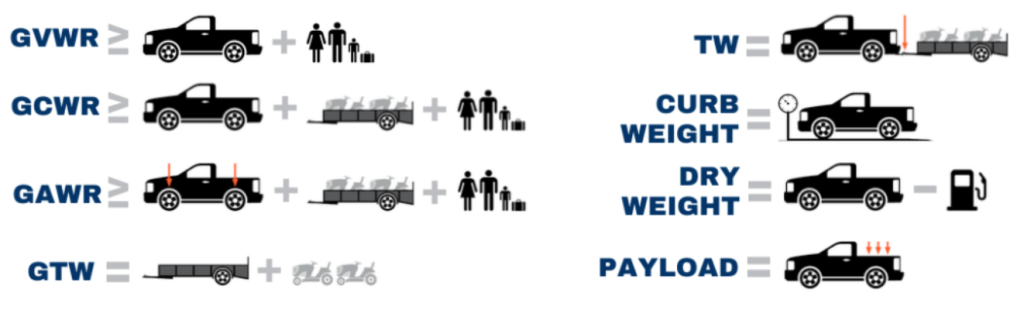
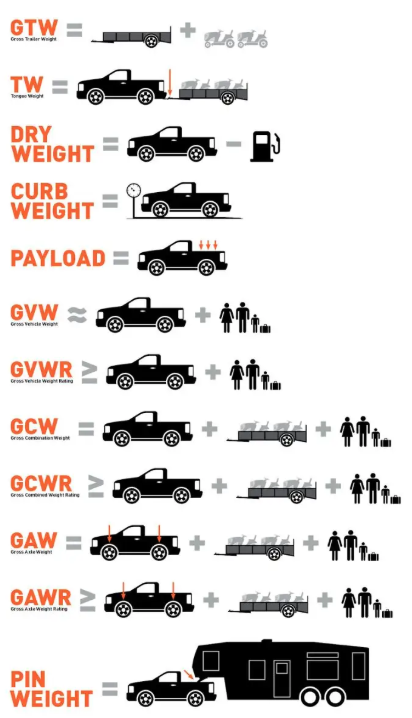
- UVW (Unloaded Vehicle Weight): The trailer’s empty weight—what it weighs with nothing loaded.
- GVW (Gross Vehicle Weight): The actual weight of the trailer when loaded—trailer + cargo.
- GVWR (Gross Vehicle Weight Rating): The maximum safe weight the trailer is rated for (empty + cargo) before things like axles or frame get overstressed.
- CCC (Cargo Carrying Capacity): The difference between GVWR and UVW (i.e., how much cargo you can legally load).
- Hitch Weight (or Tongue Weight / Pin Weight): The vertical weight that the trailer exerts on the vehicle at the hitch point. This is carried by the truck, not just pulled. The hitch weight affects the truck’s payload capacity.
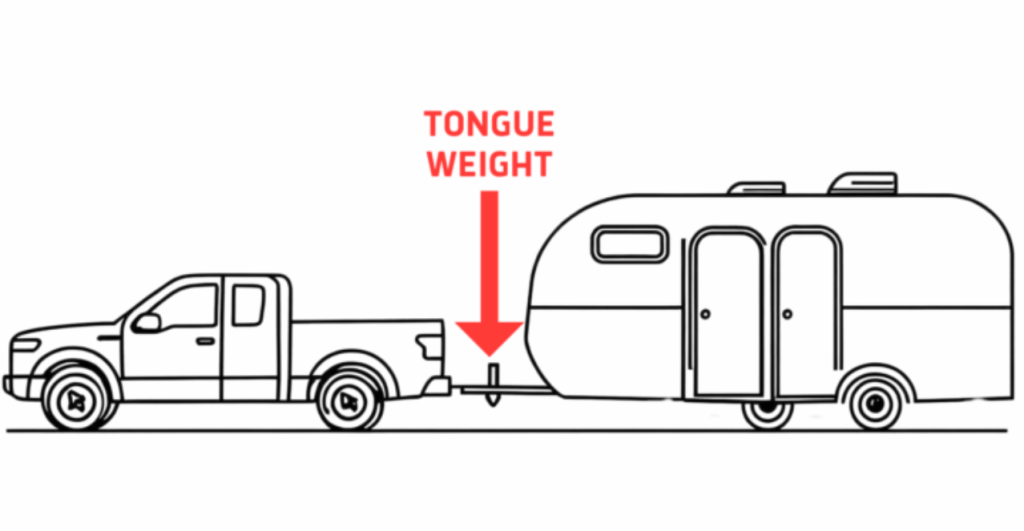
For example, even if the trailer is mostly being pulled, the portion of its weight on the tongue is still loading your truck’s rear and suspension.
Truck / Tow-Vehicle terms
- Curb Weight: The weight of the vehicle sitting ready to go (with fluids, fuel, standard equipment) but without extra cargo or passengers.
- GVWR (for the truck): The maximum weight the truck is rated to weigh (vehicle + passengers + cargo) before it becomes unsafe.
- Payload Capacity: How much weight your truck can carry inside/on it (cargo, passengers, the hitch weight) without exceeding its own rating. Payload = GVWR – Curb Weight.
- GCWR (Gross Combined Weight Rating): The total weight of the truck plus the trailer when fully loaded (truck + cargo + trailer + trailer cargo).
- Towing Capacity: The maximum weight your truck is rated to pull. It is derived from other numbers like GCWR minus the truck’s loaded weight. KBB.com
How the Truck & Trailer Interact
Now that we’ve covered the definitions, let’s look at how they all link together. The real safety in setup comes from pairing your truck and trailer in a way that respects their ratings, and knowing what to check.
Interaction 1: Trailer’s GVW vs Truck’s Towing Capacity
- Your trailer’s fully-loaded weight (GVW) must never exceed the truck’s towing capacity.
- Example: Even if your trailer’s empty weight is low, once you load it up (water, gear, cargo), the final GVW counts.
Interaction 2: Trailer’s Hitch Weight vs Truck’s Payload Capacity
- The portion of the trailer’s weight that sits on the truck (the hitch/pin tongue weight) is part of what the truck is carrying.
- That means the hitch weight + your passengers + cargo inside the truck must stay under the truck’s payload capacity.
- If you ignore it, you could have a truck that “can tow” in theory horizontally, but can’t carry the hitch weight vertically, it’s incredibly dangerous!
Formula: Finding Towing Capacity
A practical way to see what you can safely tow:
Towing Capacity ≈ GCWR – (truck’s loaded weight). Kbb.com
Where “truck’s loaded weight” = curb weight + cargo/passengers + hitch weight.
A practical way to see what you can safely tow:
Towing Capacity ≈ GCWR – (truck’s loaded weight). Kbb.com
Where “truck’s loaded weight” = curb weight + cargo/passengers + hitch weight.
What Size Truck Do You Need?

You’ve got a trailer in mind (or are browsing). How do you pick a truck size so you don’t end up underpowered or unsafe?
Step-by-Step Approach
Find the trailer’s GVWR (look at the sticker on the trailer).
Estimate weighted load: Add likely cargo, fluids, gear, passengers.

Find truck specs: In the driver-door jamb sticker and/or owner’s manual look for truck’s GVWR, curb weight, payload, GCWR. Lippert Automotive OrderHub+1
Check hitch tongue weight (often ~10-15% of trailer weight unless special design) because that hits your truck’s payload. Reading Truck+1
Apply conservative margin: Many advise using no more than ~80% of a truck’s rated towing capacity for safety & longevity. Kbb.com
Match accordingly:
- If the trailer is moderate (say < 7,000 lbs GVW), a well-equipped half-ton (½-ton) truck may suffice.
- If it’s heavier (e.g., 10,000 + lbs GVW) or involves high hitch weight (fifth-wheel, gooseneck), consider upgrading to ¾-ton or even heavy duty.
- Do not assume “because it’s a half-ton pickup, it’s automatically fine for any trailer.”
Why Trailer Length vs. Wheelbase Matters (Most People Miss This!)
Most people focus only on towing capacity and payload, but there’s a third factor that massively affects towing safety: your vehicle’s wheelbase compared to the trailer’s overall length. Even if your truck can pull the weight, it may not be long enough to control the trailer behind it.
How Wheelbase Impacts Control
Your vehicle’s wheelbase, the distance between the front and rear axles, acts like a lever against the trailer.
- Shorter wheelbase = easier for the trailer to push the truck around
- Longer wheelbase = more stable, better control at speed
If a trailer swings even 6 degrees off-center, a short vehicle gets yanked sideways far more than a long truck does. That’s the classic “tail wagging the dog” sway situation.
This is why “easy to park” doesn’t equal “good for towing.”
A vehicle with a tight turning radius (short wheelbase) is inherently less stable when towing a long trailer.
The Simple Wheelbase-to-Trailer Length Guideline
A helpful rule of thumb:
- A 110″ wheelbase can safely handle about a 20 ft trailer.
- For every additional 4 inches of wheelbase, you can add roughly 1 foot of trailer length.
Common examples:
- 130″ wheelbase → ~25 ft trailer
- 150″ wheelbase → ~28 ft trailer
This isn’t a hard legal limit, but a comfort and control threshold. The further beyond these guidelines you go, the more noticeable the sway, especially at highway speeds, in wind, or when descending grades.
Why Half-Tons Often Fall Short
- Even when towing is within limits, payload may be the bottleneck: the hitch weight + passengers + gear push you over what the truck can carry.
- Also: just because airbags or lift kits are added doesn’t mean the payload rating magically increases. These add-ons may degrade safety or ratings. Airbags are not a solution to a lacking payload rating!
Safety & Best Practice Tips
- Always check the stickers or manufacturer’s specs. Don’t rely on generic “half-ton vs three-quarter-ton” labels.
- Weigh your actual fully‐loaded trailer on a certified scale (including gear, fluids, water, propane, etc.).
- Make sure the truck’s payload capacity can handle the hitch (tongue) weight + all people/cargo inside the truck.
- Remember the trailer’s GVWR cannot be exceeded, just because you’ve lightened it doesn’t mean the rating gets higher.
- Use a conservative margin (e.g., aim for 70-80% of max) to allow for variances and ensure safety. Kbb.com
- Realize modifications (big tires, lift kits, heavier accessories) can change your payload or towing dynamics.
- If you plan to tow a fifth wheel or gooseneck, pay extra attention to hitch/pin weight, it tends to be higher.
Bottom Line — What Size Truck Should You Get?
When you boil it all down, the right truck size comes from matching your real, loaded weights to the numbers on your door sticker, it’s not a guessing game.
- For travel trailers under ~7,000-8,000 lbs GVW, with moderate tongue weight: a well-spec’d half-ton truck can work—but only if you verify all the ratings (payload + towing).
- For larger trailers (~9,000+ lbs GVW) or trailers with higher hitch weights (fifth wheels, goosenecks, heavy cargo): step up to a ¾-ton or 1-ton truck that has higher payload and towing capacity, for a safer margin.
- Always verify for your exact combination: truck trim, hitch type, gear you carry, the trailer you load.
Many properly equipped half-tons can safely handle smaller and mid-size travel trailers (usually in that under roughly 7,000–8,000 lb GVWR range) as long as both towing capacity and payload still check out once you add passengers, cargo, and hitch weight.
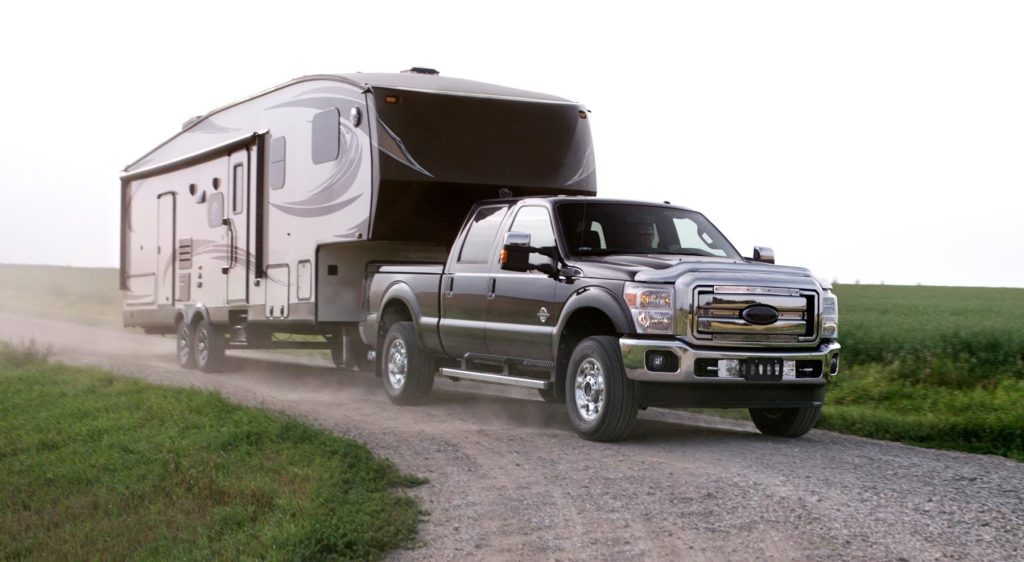
Once you move into heavier trailers, around 9,000 lbs GVWR and up, or anything with a high pin/tongue weight like most fifth wheels and goosenecks, you’re typically in ¾-ton or 1-ton territory if you want a safe margin and a truck that isn’t constantly maxed out.
It’s super important to ask yourself more than just, “Can this truck tow it?” Ask “Can this truck carry the hitch weight, my people, and my gear without blowing past payload or GVWR?” If the math says you’re right on the edge, that’s your sign to move up in truck, down in trailer, or rethink the combo before you buy.

Written By: Brooke Erickson
Some say I am a writer, I like to say I am a storyteller