We Thought a Bunkhouse Was Perfect for Us
When we first started RVing as a family, a bunkhouse felt like the obvious choice.
We had two young kids, and the idea of them having their own space just made sense. A place for their beds, their toys, their little corner of the RV that felt like “theirs.” It checked all the boxes we thought mattered at the time.
And honestly, for 4.5 years… it worked really well.
We weren’t overthinking it. We just wanted something that allowed us to travel, spend time together, and give our kids a comfortable place to sleep after long days outside. The bunkhouse layout felt practical, family-friendly, and easy to grow into.
At that stage, we weren’t thinking about long travel days, rainy afternoons stuck inside, or how quickly kids outgrow spaces. We weren’t thinking about storage, flexibility, or how we’d actually use the RV day-to-day.
We were thinking about what looked right on paper.
And to be fair, bunkhouses are a great option for a lot of families. For weekend trips, shorter stays, and younger kids, they can be exactly what you need.
But what we didn’t realize at the time was this:
The way an RV looks… and the way an RV lives… are two very different things.
And it wasn’t until we spent real time on the road that we started to understand that difference.
What We Loved About Our Bunkhouse (And Why It Worked for Us at First)
Before we get into why we made the switch from a bunkhouse to a toy hauler, it’s important to say this clearly:
We didn’t hate our bunkhouse.
In fact, there were a lot of things we genuinely loved about it, especially in the beginning.
The biggest one was simple: our kids had their own space.
At that stage, that felt like a game-changer. They had their beds, their toys, and a place that felt like theirs inside the RV. It gave them a sense of independence, and it gave us a little bit of separation, which, as any parent knows, goes a long way when you’re all sharing a small space.
For shorter trips, it worked really well.
We weren’t inside the RV all day. Most of our time was spent outside exploring, so the layout didn’t feel limiting. It gave us exactly what we needed, a comfortable place to sleep, a space to regroup, and a setup that felt easy to manage.
It also felt straightforward.
There wasn’t a lot of overthinking involved. The layout made sense, it was easy to use, and it didn’t feel overwhelming. For families just getting into RVing, that simplicity can be a huge advantage.
And honestly, for a certain season of life, bunkhouses are a great fit.
If your kids are younger, your trips are shorter, and you don’t need a ton of flexibility in how you use your space, a bunkhouse can check a lot of boxes.
But what we didn’t realize at the time was this:
What works well for how you think you’ll use an RV…
doesn’t always hold up to how you actually end up using it.
And that’s where things started to shift for us.
Follow Us on Instagram!
The Problems We Didn’t Expect
At first, nothing felt “wrong” with our bunkhouse.
But over time, little things started to add up.
The biggest one was flexibility, or really, the lack of it.
The bunkhouse gave our kids their own space, which was great… but that space could really only be used one way. It was a sleeping area. Maybe a place to play for a bit. But beyond that, it didn’t adapt to how our days actually looked on the road.
And that became more noticeable the longer we traveled.
Rainy days were probably the biggest wake-up call.
When you’re stuck inside an RV with kids for hours, you start to realize very quickly how important layout really is. The living area felt tight, the kids’ space felt crowded, and there wasn’t really a good way to separate activities. Everything was happening in the same limited space, and it started to feel chaotic.
Storage was another thing we didn’t fully think through.
As a family, you bring more than you expect, like clothes, toys, school supplies, outdoor gear. And while the bunkhouse had storage, it wasn’t designed for the amount of stuff that comes with real, day-to-day use. We found ourselves constantly rearranging, trying to make things fit, and feeling like we were always one step behind.
And then there was the biggest one:
Our kids were growing.
What felt like plenty of space at the beginning started to feel smaller and smaller. The bunks weren’t as comfortable long-term, their needs were changing, and the layout just wasn’t evolving with us.
Nothing was “broken.”
But it wasn’t working the way we needed it to anymore.
And that’s the part a lot of people don’t realize when choosing an RV…
It’s not just about what works today, it’s about what will still work a year from now.
The Moment We Knew It Wasn’t Working Anymore
For us, it wasn’t one big dramatic failure.
It was a moment that felt small at the time… but said everything.
We were on a trip, and the weather turned.
What was supposed to be a day outside turned into hours inside the RV. The kids had energy, we had things we needed to get done, and suddenly everyone was trying to use the same space at the same time.
The bunkhouse was full.
The living area felt tight.
There was nowhere to separate, nowhere to reset.
It felt like everything was happening on top of each other.
And I remember looking around thinking…
“This isn’t working the way we need it to.”
Not because the RV was bad.
Not because anything was broken.
But because our lifestyle had outgrown the layout.
We needed more flexibility.
More usable space.
More separation between “living,” “playing,” and just existing throughout the day.
And that was the moment things shifted for us.
We stopped asking, “Is this a good RV?”
And started asking, “Is this the right RV for how we actually live?”
Once that question changed… everything else followed.
Why We Started Looking at Toy Haulers
Once we realized our bunkhouse wasn’t working the way we needed it to, we knew that we always discussed wanting to have a toy hauler.
Honestly, that wasn’t something we were prepared for when we first started.
When most people think of toy haulers, they picture motorcycles, ATVs, or hauling gear, not a family living space.
But the more we talked through what wasn’t working, the more we kept coming back to the same core problem:
We didn’t need more space…we needed more flexible space.
We needed a layout that could change throughout the day.
A place where the kids could have their own area, but not one that was locked into a single purpose. Somewhere that could be a bedroom at night, a playroom during the day, maybe even a school space when needed.
And that’s when we started taking a closer look at toy haulers.
At first, it was just curiosity.
Could that garage actually work as a kids’ room?
Would it feel separated enough?
Would we lose too much living space up front?
But the more we looked into it, the more it started to click.
That garage wasn’t just storage, it was a blank space.
A space we could actually use how we needed, instead of being told how it had to function.
And for the first time, it felt like we weren’t just choosing a layout…
We were choosing a system that could adapt to our life.
What Surprised Us About Toy Haulers
Going into it, we thought we were just solving one problem, giving our kids a better space.
What we didn’t expect was how many other things a toy hauler would fix at the same time.
The biggest surprise was how versatile that garage actually was.
At night, it became a bedroom for the kids.
During the day, it turned into a playroom, a hangout space, or even a place to spread out when we needed a break from each other.
It wasn’t locked into one purpose like the bunkhouse was.
It adapted to whatever we needed that day.
And that one change made the entire RV feel bigger…well, we also did add 5 more feet 🙂
Storage was another huge difference.
Instead of constantly trying to make things fit, we suddenly had room for the things that actually come with traveling as a family, like scooters, helmets, outdoor gear, extra supplies. Things finally had a place, and we weren’t rearranging every time we needed something.
Then there was the patio.
That was something we didn’t fully appreciate until we had it. It added another layer of usable space, especially at sunsets. It gave us a place to sit, relax, and let the kids hang out without feeling like everything had to happen inside.
And maybe the biggest surprise of all…
It gave us options.
If one area felt crowded, we could spread out.
If the kids needed their own space, they had it.
If we needed a quiet moment, it was possible.
It didn’t just change where we slept.
It changed how we lived in the RV.
Why We Ultimately Made the Switch
At a certain point, it stopped being a debate.
We weren’t trying to decide between two “nice options” anymore, we were trying to solve a real problem in how we were living day-to-day.
The bunkhouse had served us well for a season.
But our lifestyle had changed.
Our kids were growing.
Our trips were getting longer.
And the way we were using the RV wasn’t what we originally planned.
We needed something that could grow with us, not something we would outgrow again in a year.
We wanted a family area where we could all site in place and watch a movie together.
And that’s what made the decision for us.
The toy hauler wasn’t just about having a garage.
It was about having a space that could change as our needs changed.
It gave us flexibility.
And once we experienced that, it was hard to imagine going back.
We weren’t upgrading just to upgrade.
We were making a change that actually made our day-to-day life easier, less stressful, and more enjoyable as a family.
And that’s when we knew it was the right move.
What Most Families Get Wrong When Choosing Between a Bunkhouse and a Toy Hauler
The first mistake is choosing based on appearance instead of lifestyle.
A layout can look perfect online or on a dealership lot, but that doesn’t mean it works for how your family moves, travels, and spends time inside the RV. What matters isn’t how it looks, it’s how it functions on a random Tuesday when everyone’s inside.
Another big one is underestimating how much time you’ll spend inside.
Everyone imagines being outside all day, and a lot of the time, you are. But the days you’re not? Weather, school days, downtime… those are the moments that really test your layout. If your RV feels tight on those days, it adds up quickly.
Storage is another area people overlook.
Families bring more than they expect. And if your layout doesn’t have a place for that, not just “storage,” but usable, accessible storage, it creates daily friction that most people don’t think about until they’re living it.
And maybe the biggest one…
Not thinking about how your needs will change.
Kids grow. Travel styles evolve. Trips get longer. What works right now might not work six months or a year from now.
That’s why we always come back to this idea:
Don’t choose an RV based on what works today.
Choose one based on how you’re actually going to use it and where you’re headed next.
Because switching RVs later is always more expensive than thinking it through the first time.
Who a Bunkhouse Is Actually Perfect For
Even though we outgrew our bunkhouse, that doesn’t mean it’s the wrong choice.
In fact, for a lot of families, it’s exactly the right one. And it was for us, for over 4 years!
It’s a great option for families with younger kids who are not outgrowing their beds and space.
At that stage, having a simple, dedicated sleeping space works really well. The bunks feel fun for them, and you’re not dealing with the same space or storage demands that come later as kids grow.
Bunkhouses also tend to feel more straightforward.
The layouts are easy to understand, easy to use, and don’t require as much adjustment or creativity to make them work. For families just getting into RVing, that simplicity can make the whole experience feel more approachable.
And for many people, that’s exactly what they need.
If you’re not trying to live in your RV for extended periods, if you don’t need a ton of flexibility in how your space functions, and if your priority is getting out and traveling without overcomplicating things, a bunkhouse can check a lot of boxes.
The key is understanding what season you’re in.
For us, a bunkhouse worked really well, until it didn’t.
Who Should Consider a Toy Hauler Instead
For the right family, a toy hauler isn’t just a different layout, it’s a completely different experience.
If you’re starting to feel like your current setup is tight, limiting, or just not keeping up with how you travel, that’s usually the first sign that a toy hauler is worth considering.
This is especially true if your trips are getting longer.
The more time you spend in your RV, the more important flexibility becomes. You need space that can adapt throughout the day, not just a layout that works at night.
Families with older kids tend to feel this shift the most.
As kids grow, they need more room, more privacy, and more ways to use their space. A garage that can function as a bedroom, hangout area, or even a place to decompress makes a huge difference over time.
It’s also a great fit if you travel with a lot of gear.
Scooters, bikes, outdoor equipment, all the things that come with family travel add up quickly. Having a dedicated space for those items doesn’t just make packing easier, it makes daily life inside the RV feel more organized and less stressful.
And then there’s the flexibility factor.
If you like the idea of having a space that can change depending on the day, a playroom, a second living area, a workspace, or just somewhere to spread out, that’s where toy haulers really stand out.
For us, it wasn’t about needing something bigger…..even though that’s nice.
It was about needing something that worked better.
And that’s the difference.
How This Played Out for Us with Alliance
As we started seriously looking at making the switch, we weren’t just comparing layouts anymore, we were paying attention to how those layouts were actually designed for real-life use.
We already knew we wanted an Alliance, even before toy hauler, we almost upgraded to a different bunkhouse floor plan earlier.
Being content creators for over 4.5 years, we have attended a bunch of RV shows and walked through a lot of RVs, so we already knew what brand we wanted to live in.
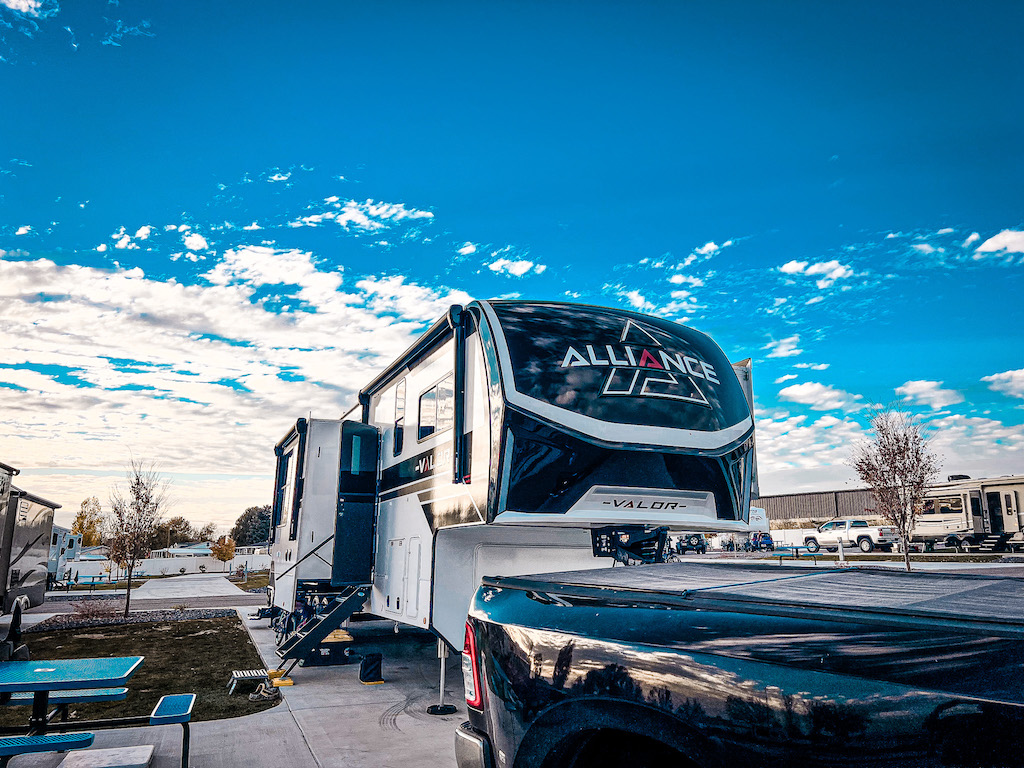
What stood out to us with Alliance, especially when we looked at the Valor 44V14, we knew the lay out was just perfect for us and so was the company.
The garage didn’t feel like an afterthought.
It felt like it was designed to actually be used as a living space.
That was a big difference for us.
It gave us the flexibility we had been missing, but in a way that still felt comfortable and functional for everyday life.
And most importantly, we were able to also have the space that allowed us to watch a movie together as a family.
And that’s what we appreciated most.
For us, the Valor made sense because of how we travel and how we use our space.
But for someone else, a bunkhouse in an Avenue or Paradigm might still be the perfect fit.
The key is understanding the difference and choosing based on how you actually live, not just what looks good when you walk through it.

Final Thoughts: It’s Not About the “Best” RV – It’s About the Right One for You
Looking back, switching from a bunkhouse to a toy hauler wasn’t about upgrading to something “better.”
It was about finding something that actually fit how we were living.
That’s the part that’s easy to miss when you’re shopping for an RV.
It’s not about which layout is the most popular, the most talked about, or even the most impressive when you walk through it.
It’s about which one works for your day-to-day life.
For some families, that’s going to be a bunkhouse, simple, functional, and perfect for shorter trips or younger kids.
For others, it’s going to be a toy hauler, more flexible, more adaptable, and better suited for longer travel or changing needs.
Neither one is “right” or “wrong.”
They’re just built for different seasons.
If there’s one thing we’ve learned through all of this, it’s this:
The best decision you can make isn’t choosing the “best RV”….it’s choosing the one that fits how you actually live, both now and in the near future.
And if you’re in that stage of trying to figure it out, asking questions, comparing options, or just feeling a little unsure…
that’s completely normal.
We’ve been there.
And sometimes, just talking it through with someone who’s lived it makes all the difference.
Find us on social media and send us a message so we can help walk you through it!

Written By: Chris & Amanda Stocker (Type1Detour)
Full-time RVers traveling the country in our Alliance Valor.